Research Blog
Short posts, paper summaries, and research updates from the GW Paleontology Lab — covering both results from our group and highlights from the broader gravitational-wave and stellar astrophysics community. Meant as a resource for anyone wanting to stay up to date on the latest in gravitational-wave paleontology. Click any entry to expand it.
Sun et al. 2026 — LIGO A♯: Detector Design and Science Prospects Beyond A+ Aug 12, 2026
Sun, Kuns, Slagmolen, Fritschel, Schmidt, Lantz, Chua, Divyajyoti, Ballmer et al. (2026) · arXiv:2608.11673
Cool paper 🆒, in which LIGO detector experts describe in detail the design and prospects of the LIGO A♯ detector that they are planning to build after LIGO A+ (the current detector design) — and before the next-generation observatories Cosmic Explorer and the Einstein Telescope. They describe the many very technical upgrades they plan to make, and how these will improve the detector.
As they say in their abstract:
Which really means: they are updating and improving many parts of these interferometers significantly — these are all pieces of reducing noise and improving the laser and the mirrors in LIGO. And that will lead to, in their words, "A♯ substantially increases compact-binary detection rates, strengthens population inference, and improves both early-warning times and localization for binary neutron star mergers. The improved sensitivity enables more detailed studies of compact-binary coalescences" — fantastic work!
Some numbers that give a sense of the jump (see their Table 3):
- Binary black holes could be probed out to redshift ≈ 4.7 or 5.6 (depending on the coating-thermal-noise scenario), instead of ~2.6 with A+.
- BBH detections increase from roughly 800 to about 3000 per year.
- BNS and BHNS detection rates increase by a factor of roughly 5 to 10.
Grondin et al. 2026 — A Framework for Linking Pre- and Post-Common Envelope Binary Properties with Star Clusters: A Massive White Dwarf+M Dwarf Binary in Alessi 12 Jul 24, 2026
Grondin, Drout, Nordhaus, Muirhead, Filer, Laroche, Webb, Broekgaarden, Chornock, Kremer, LeBaron, Margutti, Noughani, Sears & Tremblay (2026) · arXiv:2607.20611 · [publication page]
GW Paleontology group member Steffani M. Grondin's monumental common-envelope paper just hit the arXiv! One of the most important — and least understood — chapters in the life of a binary star is common-envelope (CE) evolution: the brief phase when one star swells up, engulfs its companion, and the two spiral together inside a shared envelope of gas. It is thought to be crucial for bringing binaries close enough that they can eventually merge later in life. But because it is so short-lived, it has been extraordinarily difficult to catch in the act or to constrain observationally — which is exactly why it remains one of the biggest uncertainties in the field.
In this gigantic effort, Steffani collected an enormous amount of data on the post-common-envelope system Alessi 12–PCE, using many different telescopes, and developed a new framework for recovering CE information from the detailed orbital properties of a system that has already been through the CE phase. The key trick: because this binary lives in the star cluster Alessi 12, its age, distance, and chemical composition are pinned down by the cluster, giving a wealth of extra information that isn't available for isolated field binaries.
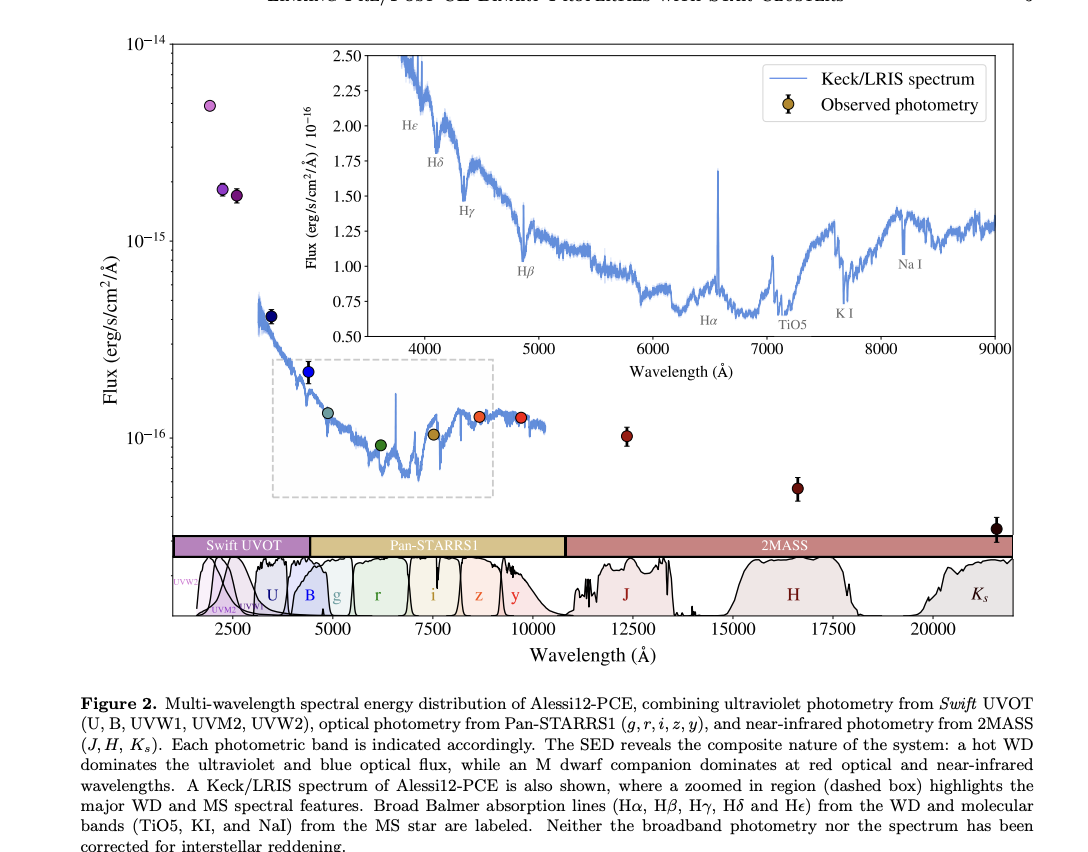
The team characterized the system in remarkable detail — identifying an M4V companion orbiting an unusually massive white dwarf of 1.06 ± 0.02 M☉ (the most massive such WD+M dwarf binary known in a cluster) on a tight 6.99-hour orbit confirmed by radial-velocity measurements.
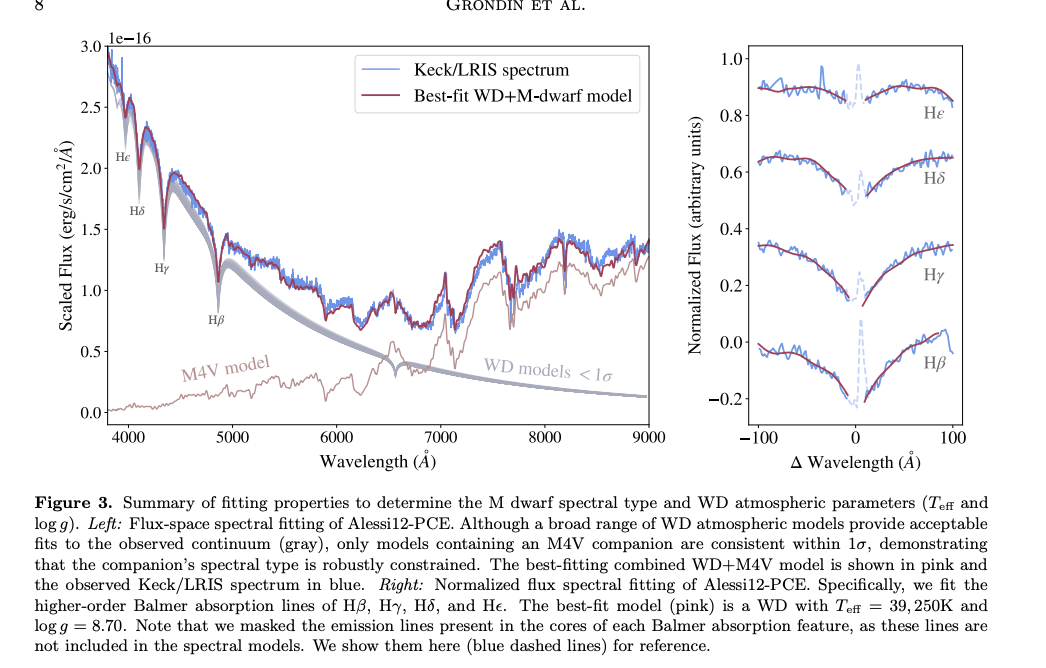
Feeding these measurements into the framework yields a striking result: CE models in which convection is the dominant physical mechanism that sets the efficiency parameter αCE reproduce the observed orbital separation in either a mid-AGB interaction with αCE ≈ 0.99, or a late-AGB interaction with αCE ≈ 0.05. That's a surprisingly wide range of possible CE efficiencies, and exactly the kind of empirical anchor that theorists modeling these systems have been missing.
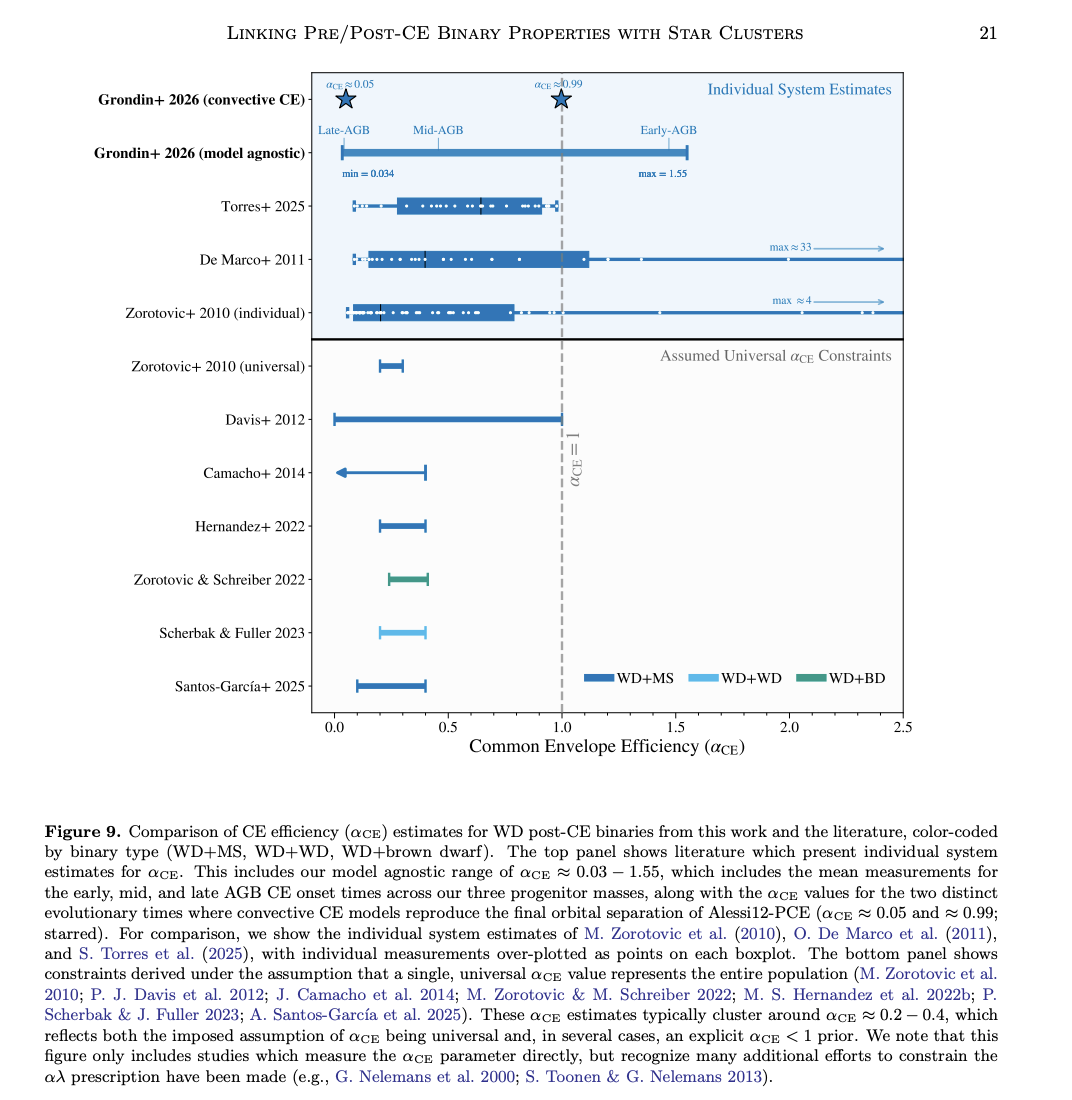
The really exciting part is what comes next: now that this framework works, it can be applied to other post-CE systems in clusters going forward — steadily chipping away at one of the most mysterious phases in binary stellar evolution. Big congratulations to Steffani and the whole team!
Cailin Plunkett — Gravitational-Wave Populations from Future Detectors: Challenges & Opportunities with Cosmic Explorer Jun 18, 2026
Fantastic talk by Cailin Plunkett on what we can learn about gravitational-wave populations and the massive stars that once formed them (or more exotic formation channels) from future gravitational-wave detectors such as Cosmic Explorer.
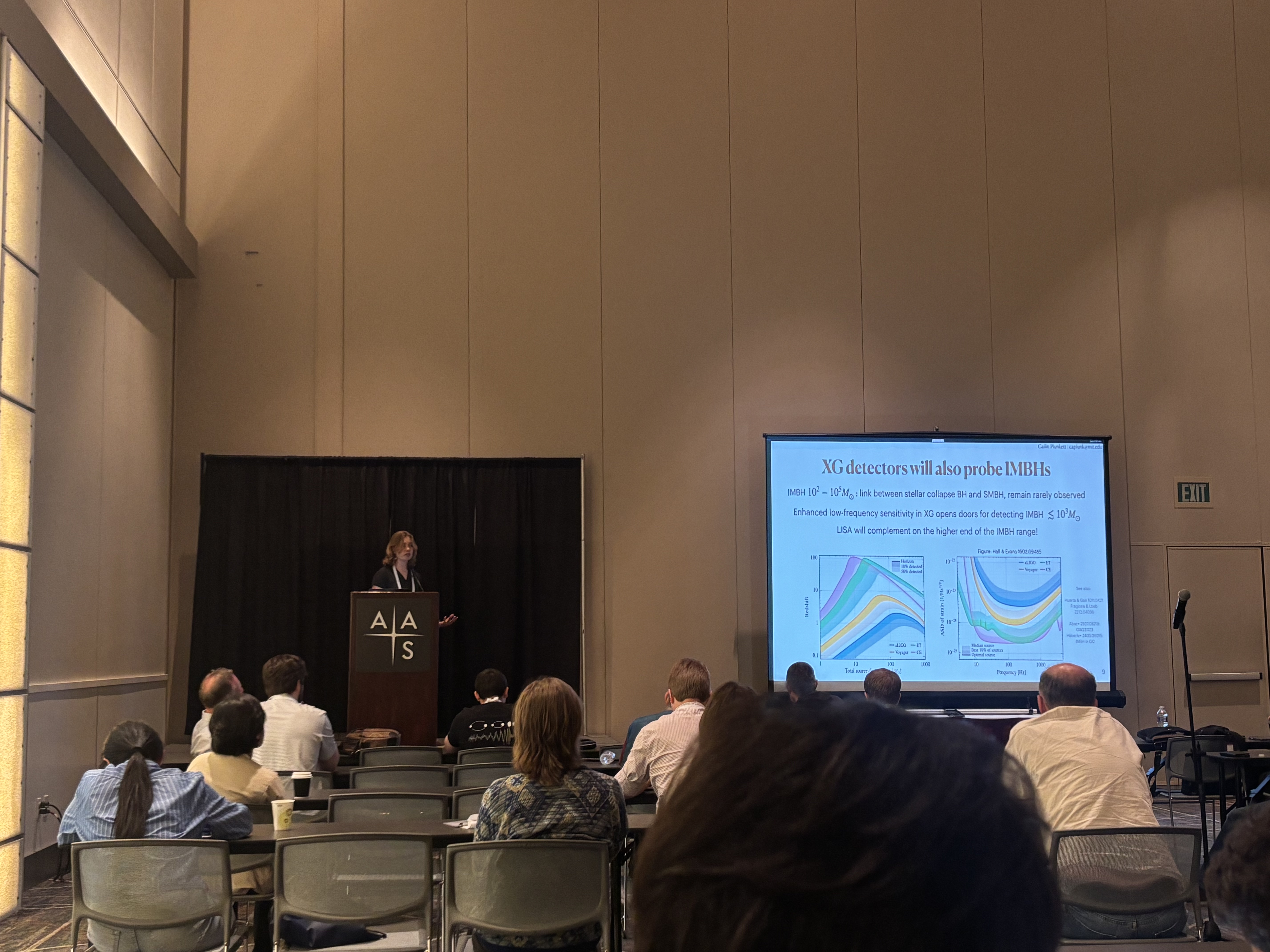
Cailin showed that there is a lot of hard work that is important to make the most of future gravitational-wave detections — when we get 100,000 of them each year with Cosmic Explorer — as well as what we can already do right now with current data. The challenges are significant due to the many different assumptions that go into the modelling, but scientists are working really hard to unravel this and overcome these challenges.
One of Cailin's recent works on this topic is arXiv:2601.07908, in which she showed that one example to overcome some of the challenges of overlapping model predictions is to move towards higher-dimensional observational data constraints — such as the joint space of effective inspiral and precessing spins — that might be a telltale signature of dynamical formation channels.
Read more about Cailin's work at cailinplunkett.github.io/about/
Alvarez-Lopez et al. 2026 — Evidence for additional structure in the effective spin distribution hints at multiple formation pathways in GWTC-5.0 Jun 11, 2026
Alvarez-Lopez, Heinzel & Vitale (2026) · arXiv:2606.12205
One of the central open questions in gravitational-wave astrophysics is: how do the binary black holes (BBHs) detected by LIGO/Virgo/KAGRA actually form? There are several competing formation channels — isolated binary evolution (two stars that live and die together), dynamical formation (two black holes that meet in a dense star cluster), AGN disk channels (mergers driven by the gas disk around a supermassive black hole), and more. The frustrating reality is that many of these channels make overlapping predictions for BBH properties such as masses and merger rates, making it difficult to disentangle them from the data.
One of the most promising distinguishing features, however, is the effective inspiral spin parameter χeff — a mass-weighted combination of the spin components aligned with the orbital angular momentum:
- Isolated binary evolution is expected to produce preferentially aligned spins (positive χeff), because tidal interactions and mass transfer tend to align the spins with the orbit before the system merges.
- Dynamical formation in dense clusters produces isotropic spin orientations — the spins have no memory of the orbit, so positive and negative χeff should appear in equal measure (a symmetric distribution around zero).
- AGN disk channels may preferentially produce higher positive χeff, driven by gas-torque alignment and hierarchical mergers.
This paper uses the new GWTC-5 catalog from LVK to look at the χeff distribution in more detail — and specifically to ask whether it shows any mass-dependent structure beyond what a simple single-population model would predict.
Their main findings:
- Across the full population there is robustly a slowly-spinning subpopulation — a Gaussian-like feature centered near χeff ≈ 0, consistent with previous analyses.
- On top of this bulk, they find mass-dependent residual structure in χeff that hints at distinct subpopulations:
- Primary masses 16–20 M☉: an excess of positive χeff (aligned spins) — consistent with isolated binary evolution, which is expected to preferentially form BBHs in this mass range with tidally aligned spins.
- Primary masses ~30 M☉: some hints of a positive χeff excess, but not yet statistically significant.
- Primary masses 46–65 M☉: negative χeff contributions become significant — pointing toward dynamical formation, where random spin orientations naturally produce a symmetric (and thus negative-inclusive) distribution.
The picture that emerges is one where different formation channels dominate at different mass scales — which makes physical sense: isolated binary evolution can more easily create the lower ~10 M☉ BH mass peak but has challenges forming BHs above ~50 M☉ due to the pair-instability supernova gap (limits set by stellar evolution), while dynamical formation can more easily produce heavier BHs (including through hierarchical mergers). The AGN channel may also contribute, particularly to the positive high-spin end.
That said, the authors are appropriately cautious: some of these trends are tentative and may shift with more data. This is exactly the kind of analysis that will sharpen considerably as LVK continues observing — O4 and beyond will substantially grow the catalog and make these mass-dependent spin features either clearer or go away. Very exciting results to watch develop!
Parkosidis et al. 2026 — Eccentricity as a probe of mass-transfer physics: Eccentric mass transfer as a solution to the wide eccentric binary problem Jun 9, 2026
Parkosidis, Toonen, Laplace & Schaffenroth (2026) · arXiv:2606.09464
Cool paper on how eccentric mass transfer can shape the orbital parameters of post-mass-transfer binaries. Most binary population synthesis codes assume that mass transfer circularizes the orbit — but as I discussed in the van Son et al. 2026 entry, observations of post-mass-transfer systems increasingly show that significant eccentricities are common and cannot simply be swept under the rug. This paper takes a concrete step toward modeling this properly.
The authors introduce the GeMT (General Mass Transfer) model, which incorporates eccentric mass transfer, and test it against a well-chosen observational benchmark: hot subdwarf B (sdB) stars paired with main-sequence companions in wide orbits. These sdB+MS binaries are particularly valuable because their orbital properties — periods, mass ratios, and eccentricities — place tight constraints on what must have happened during the mass transfer episode that formed the sdB. If a model cannot reproduce this population, something is wrong with its mass transfer physics.
The result is striking: the GeMT model naturally reproduces all the observed orbital parameters of wide sdB+MS binaries without fine-tuning. Previous models that assumed circular mass transfer struggled with this population; allowing eccentricity to develop during mass transfer resolves the tension cleanly.
The paper also explores different formation pathways depending on when Roche lobe overflow (RLOF) is initiated during the donor star's evolution, finding that this leads to distinct tracks in orbital-parameter space. Importantly, the eccentricity that emerges after mass transfer depends sensitively on:
- The amount of mass transferred
- The accretion efficiency (how much of the transferred mass the companion actually accretes)
- The angular momentum loss from the system
This is the key result from a GW paleontology perspective: because the post-mass-transfer eccentricity depends on these parameters, and because we can measure eccentricities in observed post-mass-transfer binaries, these observations can be used to directly constrain the uncertain mass transfer physics. This is exactly the kind of observational anchor the field needs — it turns eccentricity from a nuisance into a diagnostic.
More broadly, this paper reinforces the message that eccentricity after mass transfer is a real and important feature that most binary evolution codes currently neglect. For GW source modeling, this matters: if the orbital parameters of binaries entering later evolutionary stages (second mass transfer, common envelope, supernova) are systematically wrong because we assumed circularization that didn't happen, our predictions for merger rates and distributions will carry a corresponding systematic error. How large that error is remains to be quantified, but papers like this one are laying the groundwork for getting it right.
Boco et al. 2026 — Can current models predict the local black hole merger rate? Jun 3, 2026
Boco, Bosi, Sgalletta, Romagnolo & Mapelli (2026) · arXiv:2606.02725
An interesting paper. The starting point is a familiar tension in the field: binary population synthesis models of isolated binary evolution tend to predict BBH merger rates that are on the high side compared to what LIGO–Virgo–KAGRA actually measures (~14–26 Gpc⁻³ yr⁻¹). This paper focuses on one recent simulation — and notes that several others share the same problem — where the predicted local BBH merger rate exceeds the LVK-inferred value by roughly an order of magnitude.
A common response to this tension has been to suggest it can "easily" be fixed by adjusting assumptions about the cosmic star formation history (SFH) — that is, how many stars form as a function of redshift, and with what metallicities. Since BBH merger rates are strongly boosted at low metallicities (lower metallicity → less mass loss → heavier black holes → higher merger rates), tweaking the metallicity evolution of the SFH can in principle move the predicted rate up or down substantially. So: can we just tune the SFH to match observations?
What this paper does well is take that question seriously and test it rigorously. They explore a range of different SFH assumptions and — critically — they also check whether those assumptions are consistent with independent observations of the star formation history itself. This is an important step that is often skipped: it is easy to pick an SFH that makes your simulation match the GW rate, but harder to do so while also remaining consistent with what we know from galaxy surveys, cosmic metallicity evolution measurements, and related observations.
Their finding is sobering: most SFH choices that bring the predicted BBH rate down enough to match LVK would require an unrealistically metal-rich early universe — very high metal enrichment very early, leaving almost no room for low-metallicity star formation. Since it is precisely that low-metallicity population that drives such a large fraction of the BBH rate in these simulations, suppressing it enough to fix the rate tension pushes the SFH into regimes that are observationally excluded. In other words, the SFH knob is not as free as sometimes assumed. The conclusion the authors draw is that resolving the discrepancy likely requires revisions to the stellar and binary evolution physics itself — not just the input SFH.
I find the paper's framing — simultaneously varying the SFH and comparing against SFH observations — genuinely valuable, and I think more papers should do this. It puts a much more meaningful constraint on what kinds of "fixes" are actually physically acceptable.
That said, this paper has made me want to think more carefully about which recent models actually do predict low BBH rates, and what the physical ingredients are that make that possible. So: more coming soon on that front — stay tuned!
Broekgaarden et al. 2026 — How Common Are Common Envelopes? Quantifying Their Role in Forming Gravitational-Wave Sources Jun 4, 2026
Excited that my paper is out! This was a team effort: Floor S. Broekgaarden, Ana Lam, Sasha Levina, Jakub Klencki, Kyle A. Rocha, Lieke van Son, Steffani M. Grondin, Monica Gallegos-Garcia, Brian D. Metzger, Enrico Ramirez-Ruiz, Angela Twum, Melanie Santiago, Julia Haynes, Tyler B. Smith, Amedeo Romagnolo, Edo Berger, and Lucas M. de Sá
arXiv:2606.05322
All data and results are publicly available with interactive figures and tables you can explore yourself: [interactive catalog]
One of the most consequential — and most uncertain — phases in the life of a binary star system is common-envelope (CE) evolution. When one star grows large and engulfs its companion, the two stars spiral together inside a shared gas envelope. If the system survives, the orbit shrinks dramatically, setting up the binary to eventually merge as a pair of compact objects detectable by LIGO, Virgo, and KAGRA. If it doesn't survive, the binary is destroyed. CE evolution is therefore a critical bottleneck in forming gravitational-wave sources — yet after decades of study, we still don't fully understand it.
This paper asks a deceptively simple question: is CE evolution actually required to form the binary black holes, neutron stars, and black hole–neutron star systems that gravitational-wave observatories detect? Rather than picking a single simulation and reporting its answer, we compiled and compared predictions from over 200 population-synthesis simulations spanning many different codes and physical assumptions, and asked what fraction of merging systems in each simulation formed through a CE phase.
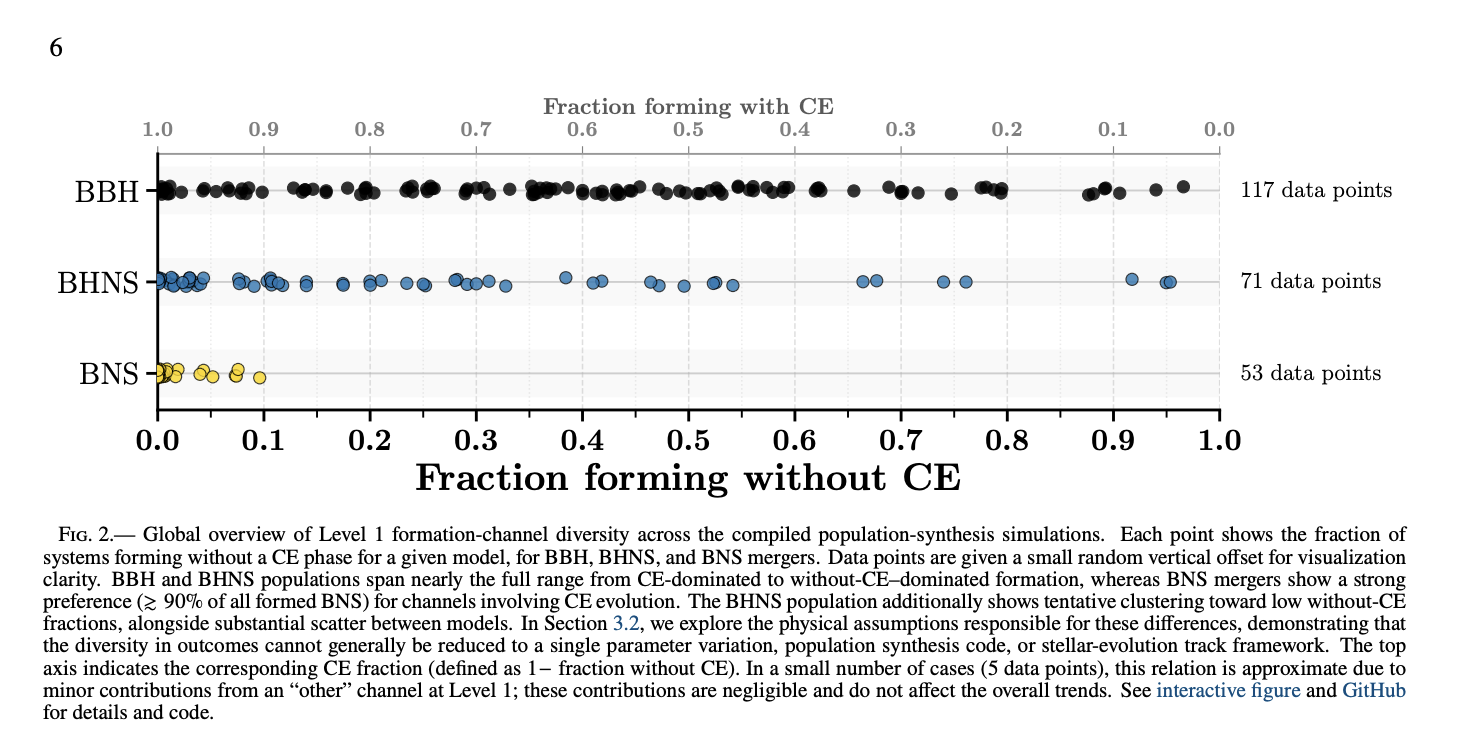
The headline result (Figure 2) is striking: for binary black holes and BH–neutron star systems, the simulations span nearly the full allowed range — from models where essentially every merger formed through a CE phase to models where none did — yet these same models all produce similar merger rates consistent with current LVK observations. This reveals a fundamental degeneracy: merger rates alone cannot tell us how these systems formed. We can match the data with completely opposite physical assumptions about CE evolution.
Binary neutron stars tell a very different story. Across essentially all models, BNS mergers form almost exclusively through channels involving at least one CE phase (≳90–100%). This makes BNS systems a much more powerful probe of CE physics — if we can measure their merger rates and mass distributions precisely enough, we can potentially break the degeneracy that plagues the BBH population.
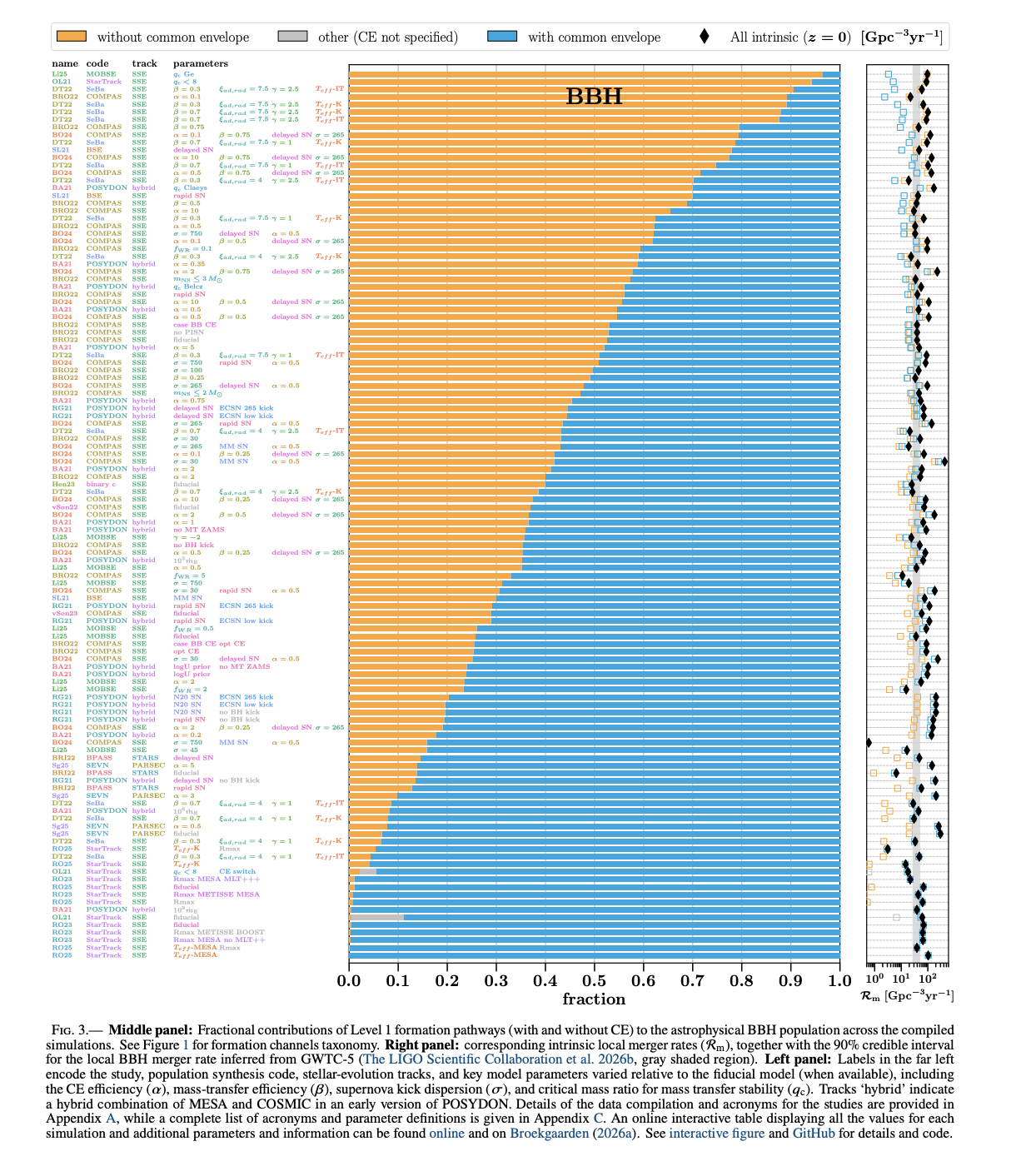
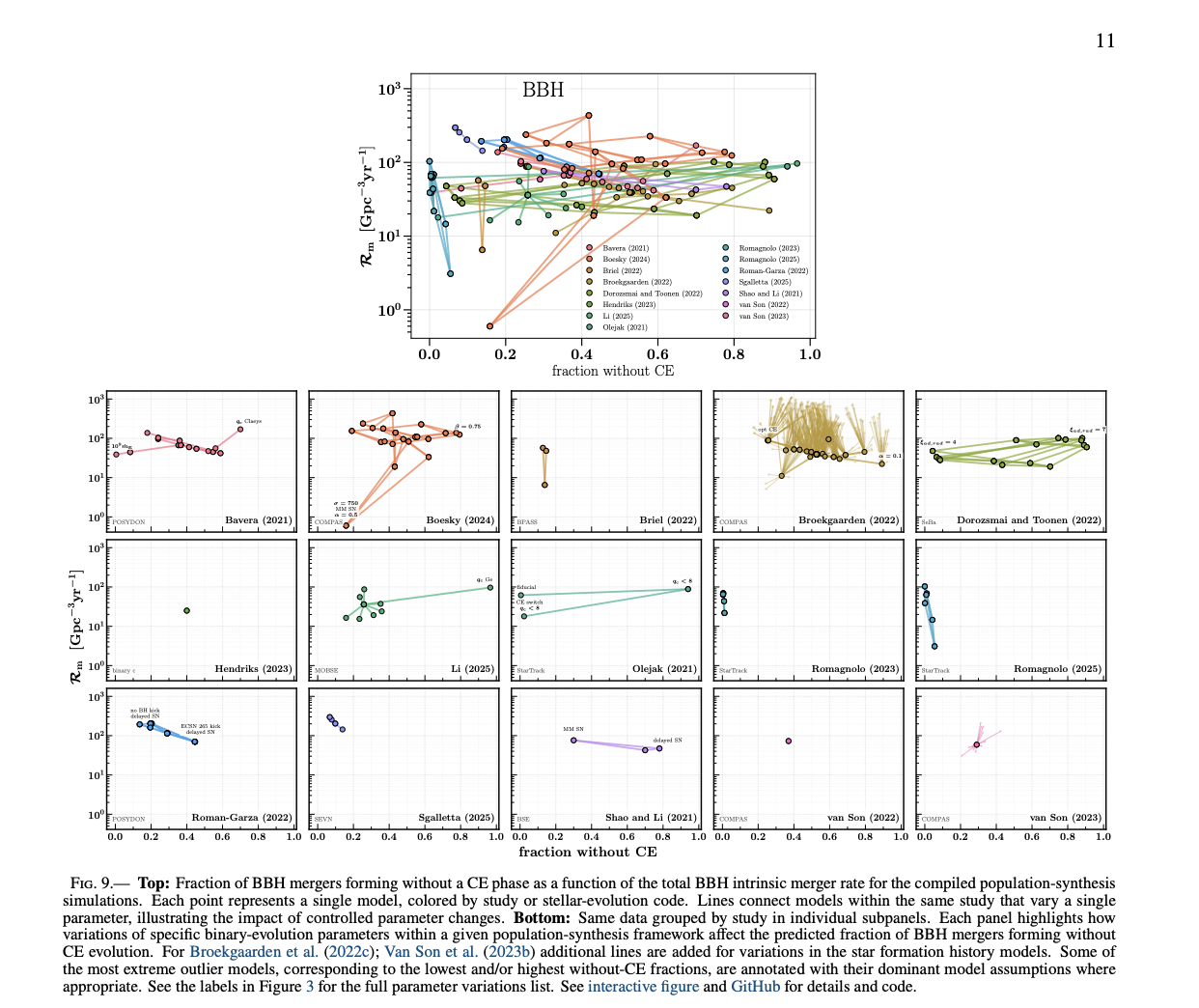
The bottom line is that we need to go beyond merger-rate measurements alone. Multi-messenger observations, mass and spin distributions, delay-time distributions, and eventually electromagnetic counterparts will all be needed to break the degeneracy and constrain what CE evolution actually looks like. The interactive catalog accompanying this paper is designed to make it easy to explore the full simulation landscape and identify which observables are most diagnostic. There is much more work to do here — but this paper is intended as a community resource to anchor those future efforts.
van Son et al. 2026 — Post-Mass-Transfer Binaries: A Living Catalog & Unified Review Jun 1, 2026
van Son, Yamaguchi, Nagarajan, Shenar, Sen, Laroche, Leiner, Sana & Pols (2026) · arXiv:2605.31290 · Interactive Catalog
Parts of the summary below are based on text and highlights provided by lead author Lieke van Son — with thanks and credit to her and the full author team.
Super cool paper on the arXiv today that is directly relevant for gravitational-wave paleontology — and honestly, one I've been hoping someone would write for a while.
Mass transfer is one of the most uncertain and consequential phases in binary stellar evolution. Whether a binary survives a mass transfer episode, and what happens to its orbital properties — separation, eccentricity, mass ratio — in the process, largely determines whether it can eventually form a merging compact object binary. Despite its central importance, mass transfer has been notoriously hard to constrain observationally, especially for massive star binaries where data has historically been very sparse. (For a great recent review of how little we know, see Marchant & Bodensteiner 2023.)
What makes this new paper so exciting is that the observational landscape is changing — fast. New surveys like Gaia, combined with a wealth of X-ray binaries, spectroscopic binaries, pulsar binaries, and a rapidly growing body of observations of binaries with white dwarfs, are flooding us with new data. Van Son et al. bring all of these together into a single unified catalog and review — a living, community-maintained resource of over 5,400 post-mass-transfer systems — and by doing so they are able to highlight patterns that would be invisible when looking at any one population in isolation.
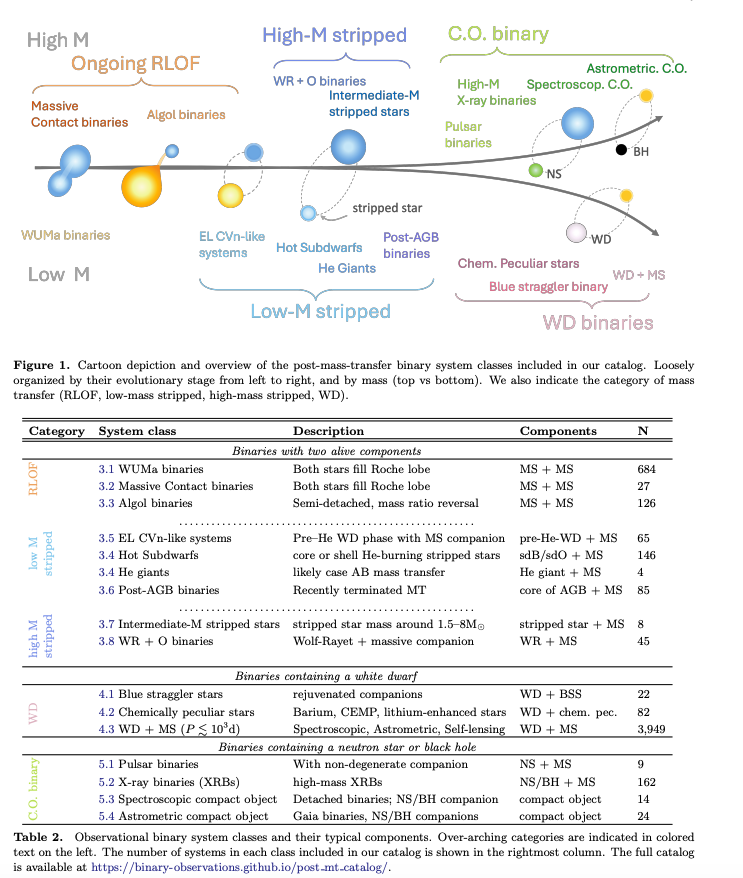
The headline result — and the one I find most important for GW paleontology — is about eccentricity. One of the standard assumptions baked into most binary population synthesis codes (including the ones we use to model gravitational-wave sources) is that binaries circularize after mass transfer. This paper challenges that assumption head-on.
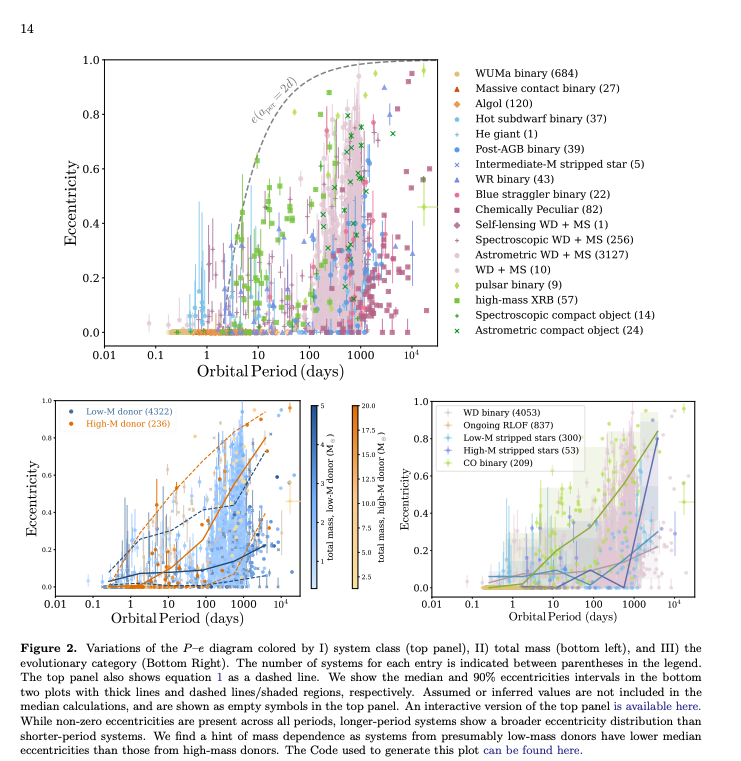
Looking at the full population together (Figure 2), a clear picture emerges: non-zero eccentricities are common throughout, across all periods and system classes. This is not a quirk of one exotic subpopulation — it appears to be a generic feature of binaries after mass transfer. The three key results I'd highlight:
- Post-mass-transfer systems are not circular. The data firmly constrains the median eccentricity as a function of log period, and circular is not a good description — at least for a significant subset of systems at most periods.
- Systems from presumed high-mass donors are more eccentric than those from low-mass donors. This asymmetry is a tantalizing hint that natal kicks — the velocity kick a neutron star or black hole receives at birth — may be playing a role in pumping up eccentricities in the more massive systems.
- The Gaia BH and NS systems are not outliers — except in mass ratio for the Gaia BHs. In terms of orbital properties, they appear to be part of the same broader post-mass-transfer population. This is a really striking result: rather than being mysterious one-off systems, these Gaia discoveries may be telling us something about binary mass transfer that applies much more generally — especially the wide WD+MS systems that have long been an outlier in our theoretical models.
The interactive online version of the catalog is genuinely fantastic, and potentially even more impactful than the paper itself:
→ binary-observations.github.io/post_mt_catalog/
You can sort, filter, and download the data; browse through interactive plots; and even suggest a missing system via a built-in interface to help improve the resource. This is community science done right.
From a GW paleontology perspective, the key takeaway is clear: we need to revisit the circularization assumption in our population synthesis simulations. If post-mass-transfer binaries are generically eccentric, then modeling their subsequent evolution — including how eccentricity affects later mass transfer episodes, supernova dynamics, and final merger timescales — matters. Eccentric mass transfer is technically hard to implement, but this paper makes the observational case for why it cannot keep being ignored. This is exactly the kind of observational anchor that GROWL-style frameworks need to pull against.
Big congratulations to Lieke van Son and the whole team on this one — it's a team effort and a major community resource.
GWTC-5: My Summary of the New Gravitational-Wave Catalog May 29, 2026
This is my astrophysics-focused summary of the new GWTC-5 gravitational-wave catalog papers released by the LIGO–Virgo–KAGRA (LVK) collaboration. It is a biased summary: I come at this from the angle of trying to use gravitational-wave data to understand the lives of massive stars, and the results I find most exciting reflect that. I gave a talk on this for the group this week; some of the thoughts below are drawn from that discussion.
Part I: What is GWTC-5?
GWTC-5 was released earlier this week — a suite of at least eight papers plus a new catalog. In a sentence: LVK has announced their gravitational-wave detections from the second half of their fourth observing run (O4b), analyzed the full combined dataset, and released a range of scientific results built on those detections.
Three things happened simultaneously:
- LVK published the new individual compact-binary merger detections from O4b, including estimated source properties (masses, spins, distances).
- These are added to previous detections from O1, O2, O3, and O4a, forming GWTC-5 — the fifth gravitational-wave transient catalog, with over 390 candidates in total.
- Using this expanded dataset, LVK analyzed population properties, cosmological constraints, tests of general relativity, and lensing signatures — each as a separate companion paper.
One thing I love about this release is the video below, originally shared by Gabriele Vajente. It shows the growth of the "stellar graveyard" — a visualization of the masses of all compact objects detected with gravitational waves, accumulating over time from O1 through O4b. It really drives home how rapidly this field is growing.
The catalog now contains 391 events. When I started working in gravitational waves around 2016, we knew all the event names by heart. Those days are gone.
Part II: The Companion Papers (Brief Overview)
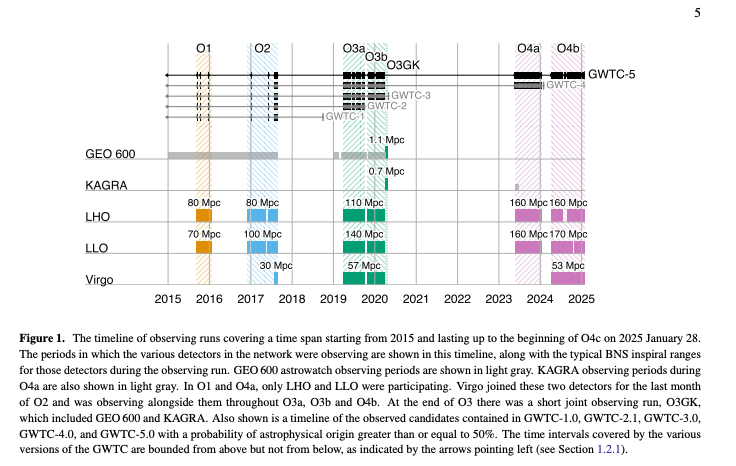
- Intro: arXiv:2605.27223 — overview of observing runs, detector network, and catalog conventions
- Methods: arXiv:2605.27224 — how raw data become a catalog of events
- Open Data: arXiv:2605.27090 — what data are publicly available and how to access them
- GWTC-5 Catalog: arXiv:2605.27225 — the new detections from O4b ⭐
- GW Populations: arXiv:2605.27226 — population properties of compact binaries ⭐
- Constraints on the Cosmic Expansion Rate: arXiv:2605.27227
- Tests of General Relativity (to be published)
- Searches for GW Lensing Signatures (to be published)
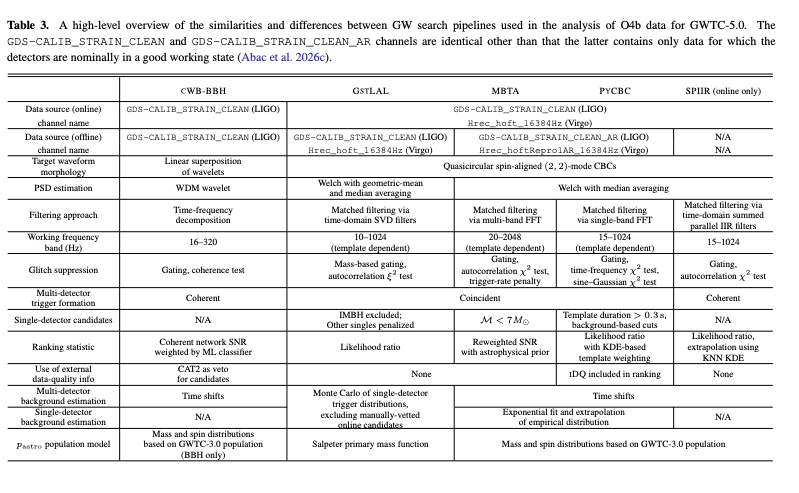
The Methods paper describes the full pipeline from raw detector data to a catalog entry. The table below shows the different independent search pipelines used — each has its own strengths, and having multiple is important since some events are only found by one pipeline.
The Open Data paper sets a high standard for open science — every figure in the papers can be reproduced from downloadable data files, with independent parameter-estimation pipelines from groups outside LVK also publicly available. That is not trivial, and it is something our community should be proud of.
Part III: The Catalog Paper — New Detections from O4b
The Numbers
- 161 compact binary coalescence candidates with pastro > 0.5
- 104 events with FAR < 1 yr−1 — high-confidence catalog (~88% purity)
- All consistent with binary black holes (BBH) — no BNS or NSBH systems
- 5 BBH signals with network SNR > 30, with the highest ever recorded SNR of 76.9 for GW250114_082203
- Combined with previous catalogs: 390 total candidates with pastro ≥ 0.5
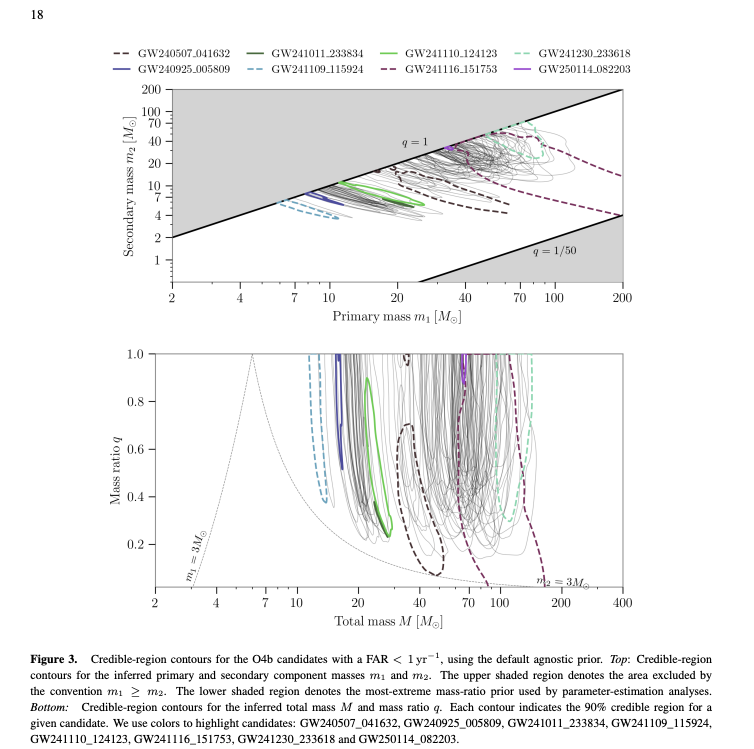
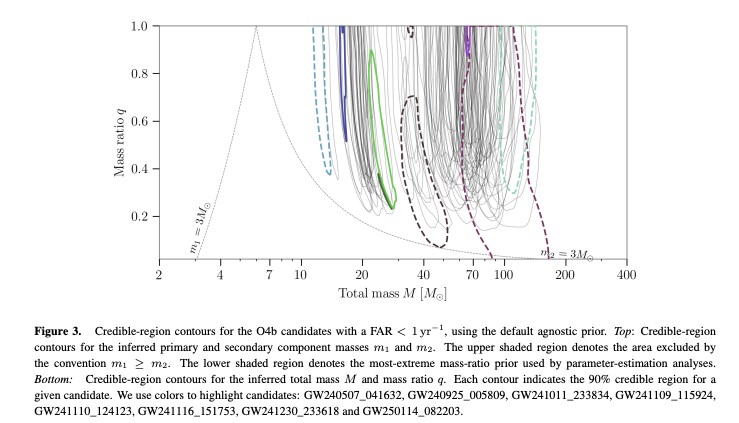
Highlighted Events
Total mass ~25 M☉, mass ratio ~1:3, with a misaligned primary spin (χeff ≈ +0.5) — suggesting a possible hierarchical merger origin in a dense stellar environment. The closest of the new O4b candidates, at ~0.21 Gpc.
May be the first GW event to require a negative effective inspiral spin (χeff = −0.31+0.23−0.18). Another possible hierarchical merger candidate. I'll return to what this means for spin population inference below.
90% credible sky area of just 6 deg2 — an extraordinary improvement enabling much more targeted electromagnetic follow-up. Typical GW events are localized to hundreds or thousands of square degrees.
The highest network SNR ever recorded: 76.9. For reference, GW150914 — the first detection — had an SNR of about 24. This allows very precise measurements of source properties and stringent tests of general relativity.
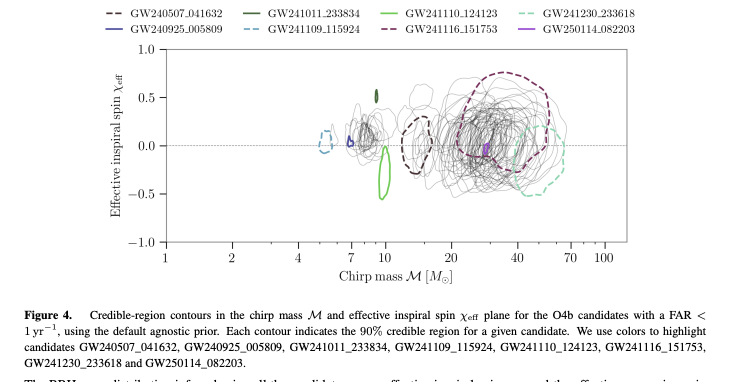
Part IV: The Populations Paper
The Populations paper (arXiv:2605.27226) asks: what is the distribution of masses, spins, and merger rates across the full population? Two complementary approaches are used:
| Parametric model (FullPop) | Non-parametric model (PixelPop) |
|---|---|
| Assumes a specific functional form; infers a small set of parameters. Strong assumptions, low statistical uncertainty. | Divides parameter space into bins; infers rate in each bin directly. Fewer model assumptions, but more uncertainty. |
Merger Rates
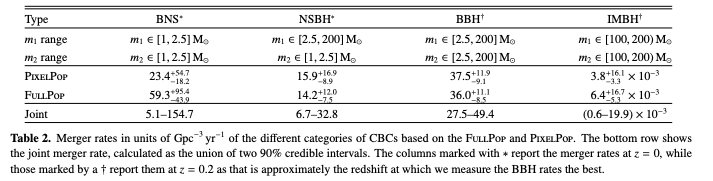
- The BNS rate has decreased somewhat compared to earlier estimates — earlier high estimates were heavily influenced by GW170817, a very nearby event. As the sample grows, the rate converges to something more reliable.
- The BBH rate remains broadly consistent with previous estimates, with slightly smaller uncertainties.
- There is a non-zero IMBH rate — tantalizing, but very uncertain.
Mass Distribution
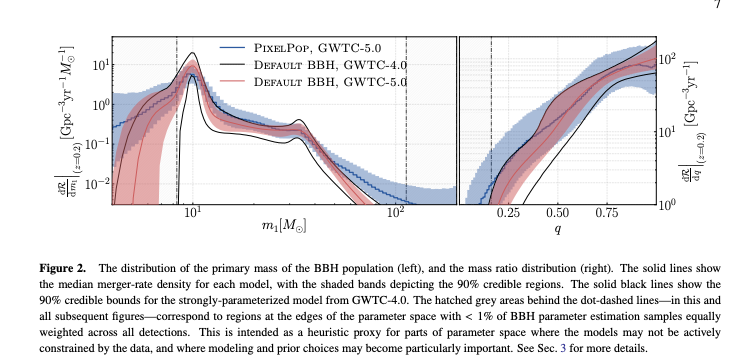
- No empty gap between 3–5 M☉. GWTC-5 rules out a completely empty lower mass gap — this is now solidly established.
- Features at ~10 M☉ and ~35 M☉ persist across models. Their origin is debated.
- No clean pair-instability supernova (PISN) gap. The distribution extends smoothly past 50 M☉ — likely because hierarchical mergers in dense environments fill in any intrinsic PISN gap.
- The mass ratio distribution peaks near q = 1 (equal mass), declining gradually toward more unequal ratios.
The χeff Puzzle
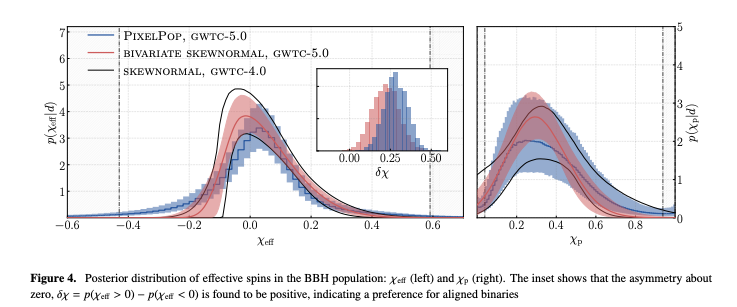
This is the result I find most striking — and most confusing:
- The χeff distribution is asymmetric: more systems have spins aligned with the orbit than anti-aligned.
- At least 9–40% of mergers must originate from preferentially aligned channels (e.g., isolated binary evolution) to explain the asymmetry.
- Yet the models also find that ~39% of binaries have negative χeff — which, if true, would imply the majority of events come from dynamical formation.
My honest take: I am not convinced. Spin inference is notoriously difficult and strongly correlated with mass ratio. The PixelPop smoothness prior will always spread a near-zero distribution into both positive and negative territory. I want to see more high-SNR events like GW241110 that individually require negative χeff before drawing firm conclusions. That said, the positive asymmetry is real and persistent — at least some isolated binary evolution contribution is hard to avoid.
The χeff–q Correlation: a Puzzle That Is Fading
Since GWTC-2.0, several analyses had reported a trend where more unequal-mass systems tend to have higher χeff. GWTC-5.0 finds decreased evidence that the mean of χeff evolves with q — suggesting the earlier signal may have been partly a statistical fluctuation, which simplifies the formation interpretation considerably. A broadening of the χeff distribution at certain mass ratios may still be real, and warrants follow-up.
Redshift Evolution
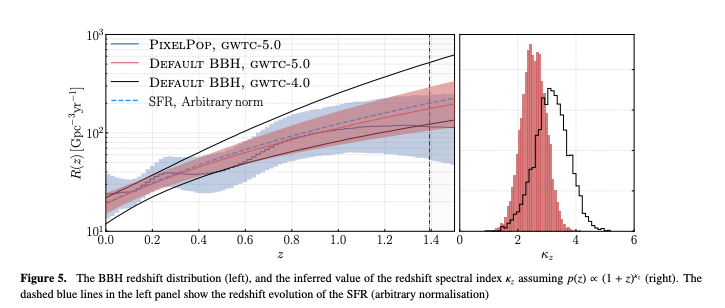
The BBH merger rate rises with redshift, broadly following the star-formation rate — as expected. But the new inferred slope is slightly shallower than in previous catalogs. This may favor longer delay times between star formation and merger, or a steeper metallicity dependence.
Final Thoughts
GWTC-5 is an extraordinary release. A few things I personally find most exciting or most puzzling:
- No neutron star detections in O4b. Binary neutron stars are rare — or their merger rate is lower than early estimates. For those of us studying r-process enrichment and heavy element origins, this matters.
- The ~10 M☉ and ~35 M☉ features are real and persistent. These are crying out for a systematic comparison to theoretical models across a large range of stellar physics assumptions.
- No PISN gap. Multiple formation channels are clearly overlapping in the observed spectrum.
- The χeff–q mean correlation is weakening — good news for formation theory.
- The spin story is genuinely confusing. Something about inferring populations from noisy individual measurements is making this hard to interpret. I'd rather wait for more high-SNR events before drawing firm formation-channel conclusions.
- GW250114 with SNR = 76.9 is a gift. High-SNR events do more science per event than many low-SNR detections combined. Improving detector sensitivity is genuinely the best path forward.
It's a great time to be in this field.
Note: This is a personal summary written from an astrophysics/formation-theory perspective. For the authoritative results, please refer directly to the LVK papers linked above. All figures are from the LVK GWTC-5 papers, reproduced here for educational commentary.
Smith et al. 2026 — Massquerade: Impacts of Mass Ratio Reversals on Binary Black Hole Merger Rates and Mass Distributions May 20, 2026
Tyler B. Smith, Floor Broekgaarden, Sasha Levina, Amedeo Romagnolo, Manasvini Komandur, Melanie Santiago, Kyle A. Rocha
arXiv:2605.21580
When two massive stars are born together in a binary system, the heavier star is expected to also produce the heavier black hole when it dies. But binary evolution can flip this expectation. Through a process called mass ratio reversal (MRR), the initially less massive star can end up forming the more massive black hole. This happens when mass is transferred between the stars during their lives — the lighter star receives material from its companion, grows a more massive core, and ultimately collapses into a heavier black hole than the one formed by the originally dominant star. The initially less massive star is then "massquerading" as the primary.
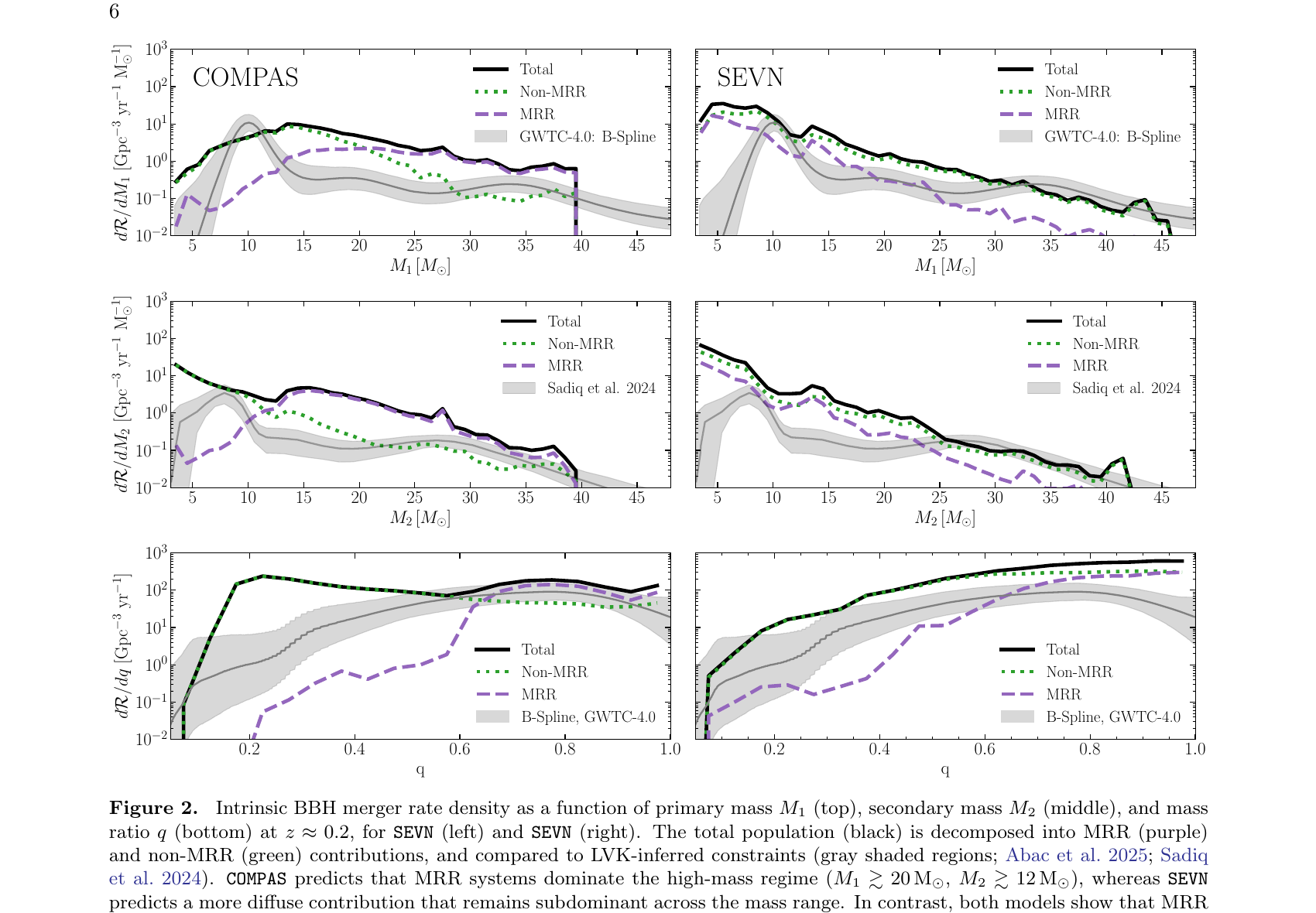
This paper investigates how common MRR is, and — crucially — how it shapes the black hole merger rate and mass distributions that gravitational-wave observatories like LIGO, Virgo, and KAGRA actually measure. The team uses two independent binary population synthesis codes, COMPAS and SEVN, to simulate large populations of binary stars from birth through to black hole merger, and compares the resulting distributions against current LVK observations.
A key finding is that the two codes make qualitatively different predictions. In COMPAS, MRR systems dominate the high-mass end of the distribution (primary masses above ~20 M☉, secondary masses above ~12 M☉), while in SEVN the MRR contribution is more diffuse and remains subdominant across the full mass range. Despite this difference, both codes agree that MRR systems preferentially populate the high mass-ratio regime (q ≳ 0.6, meaning the two black holes have similar masses). The upshot is that the observed mass distribution cannot simply be read as a direct map of the original stellar masses — MRR blurs that connection.
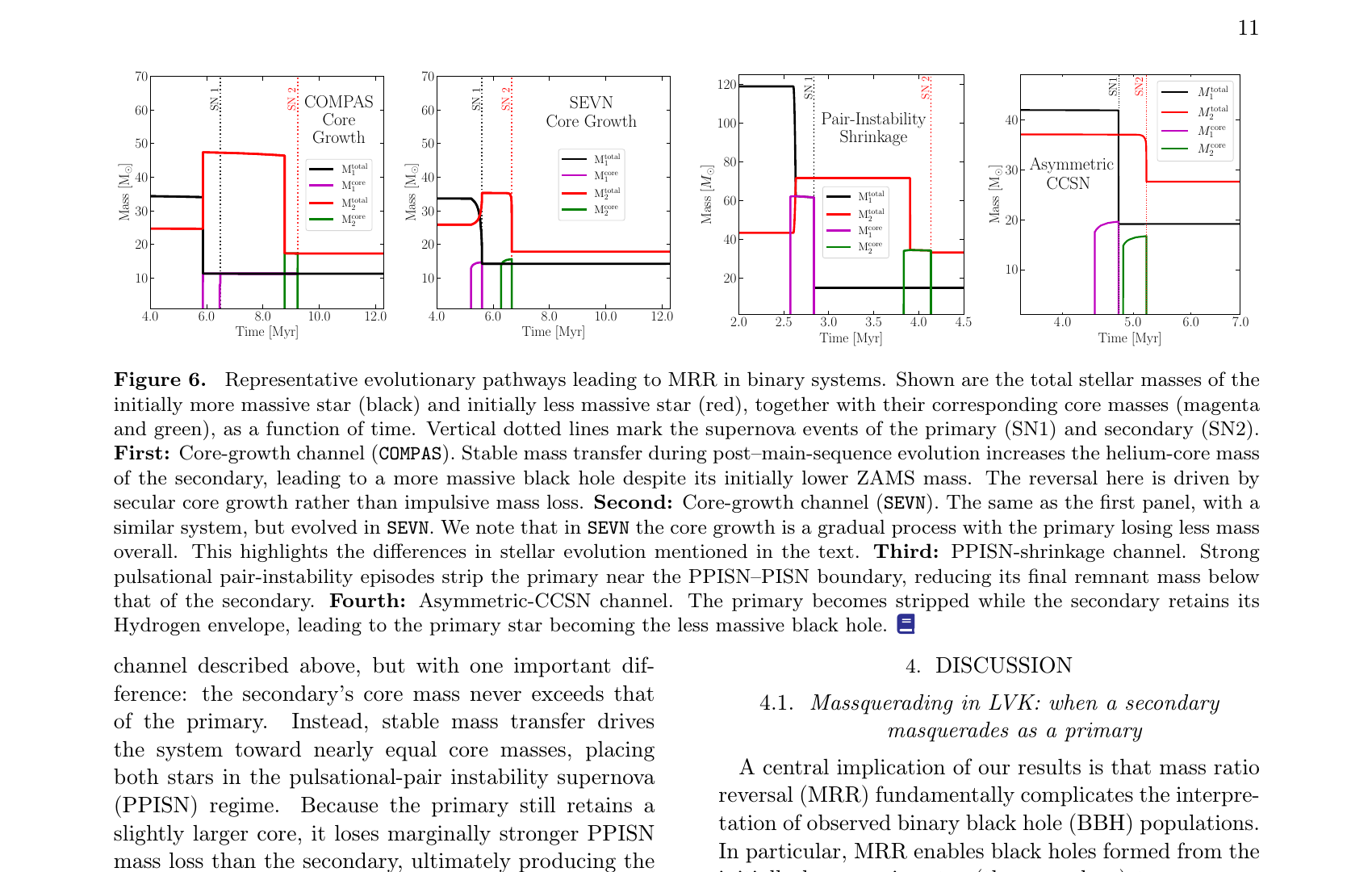
The paper also identifies three distinct evolutionary channels that produce MRR (Figure 6 below): (1) core growth, where stable mass transfer fattens the secondary's helium core until it collapses into the heavier black hole; (2) PPISN shrinkage, where the primary loses mass through violent pulsational pair-instability episodes and ends up lighter than the secondary; and (3) asymmetric core-collapse supernovae, where differential stripping leaves the secondary with a heavier remnant.
Schiebelbein-Zwack & Fishbach 2026 — Forbidden Formation Histories: The Binary Black Hole Merger Rate Disfavors Long Delay Times May 13, 2026
Schiebelbein-Zwack & Fishbach (2026) · arXiv:2605.12858
Very cool paper. The central idea is an elegant inversion: the BBH merger rate is normally thought of as a convolution of the BBH formation rate with a delay time distribution p(t) — that is, how long it takes from when two massive stars are born to when the resulting black holes finally merge. Usually we assume a formation rate (tied to the star formation history) and a delay time distribution, and predict the resulting merger rate. Here, the authors turn this around: they take the observed BBH merger rate from GWTC-4 as input and ask what BBH formation histories and delay time distributions are consistent with it. Really cool idea.
In particular, they use this framework to ask which delay time distributions produce "physical" results — meaning the implied BBH formation rate must be non-negative and broadly consistent with what we'd expect from stars forming across cosmic time. The punchline is that delay time distributions with shallow power-law slopes (α ≳ −0.7) get into trouble: they concentrate too many mergers at low redshift, producing a pile-up near z ~ 0 that is hard to reconcile with the observed redshift distribution. Since shallow delay time distributions are thought to be associated with the stable mass transfer channel, the paper argues these are disfavored.
I find the general approach genuinely interesting — it is a direct attempt to connect the population-level GW observations back to the massive stellar binaries that formed them, without having to commit to a specific simulation. That kind of inversion is powerful in principle and I would love to see it developed further.
- Redshift-independent delay time distribution. The paper assumes p(t) does not evolve with redshift, but this is very unlikely to be true. At higher redshifts, BBHs form preferentially from lower-metallicity stars, and we have good reason to think this shapes the delay time distribution — both through its effect on the mass-transfer physics and on the black hole masses produced. The observed data likely already contain this metallicity-driven evolution baked in, so assuming a fixed p(t) may be absorbing real physical evolution into the inferred constraints.
- Single-channel assumption. The analysis implicitly treats the BBH population as coming from one channel with one characteristic delay time distribution. But dynamical formation in dense stellar environments (globular clusters, nuclear star clusters) contributes to the observed rate and likely brings its own different delay time distribution — or more precisely, a different relationship between formation time and merger time altogether. If the dynamical channel contributes meaningfully at certain redshifts, it could mimic or mask the signatures the paper is attributing to the isolated stable mass transfer channel.
- Shape of the delay time distribution. The conclusions depend on the assumed functional form for p(t). It is a bit unclear from the paper how exactly the delay time distribution is derived or how sensitive the results are to that choice — a more complex or bimodal shape could change the picture.
All in all, an interesting paper that pushes in exactly the right direction: using the redshift evolution of the BBH merger rate as a probe of the massive star progenitors. I am definitely interested in seeing more work like this, with the caveats above incorporated!
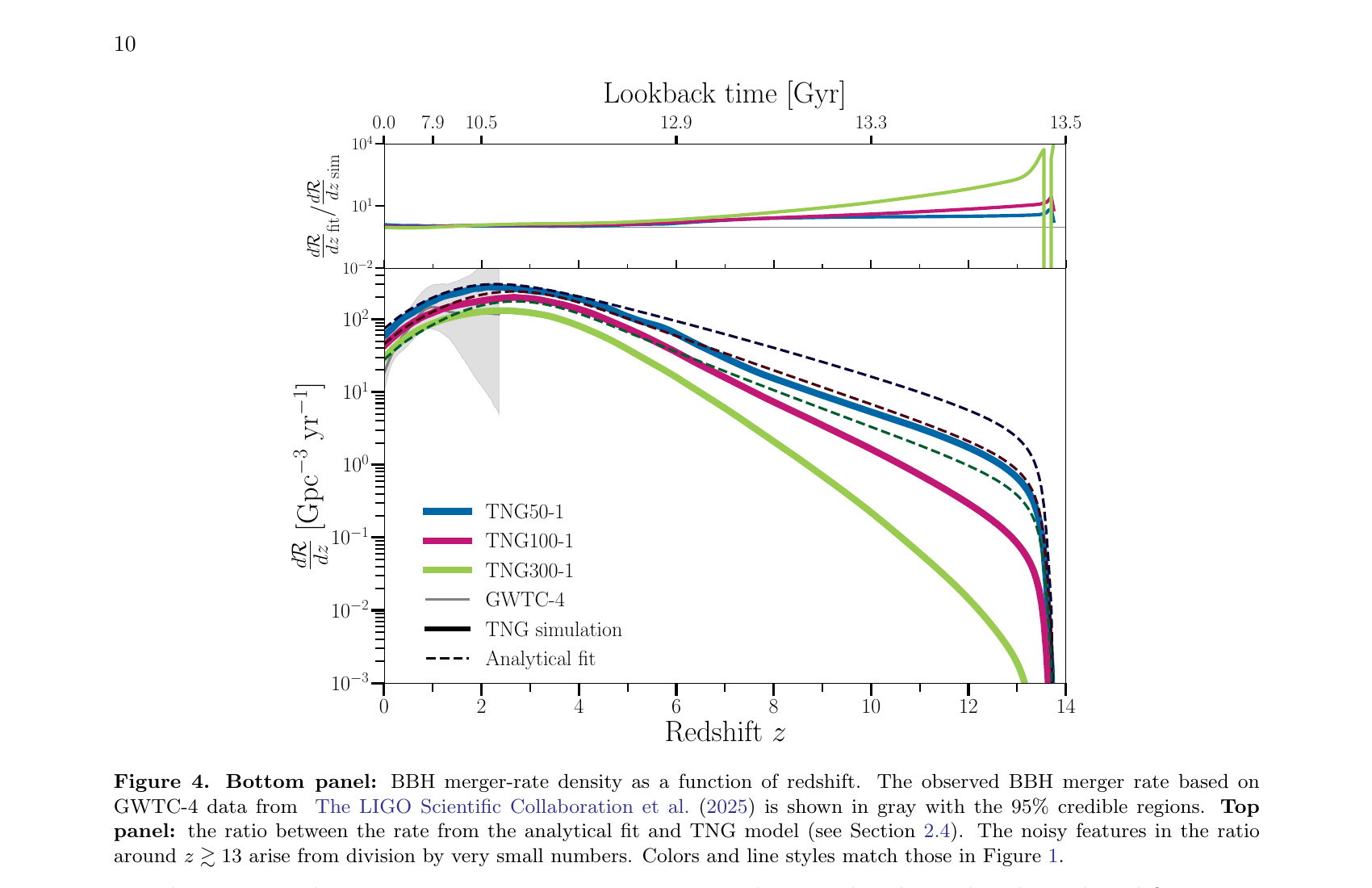
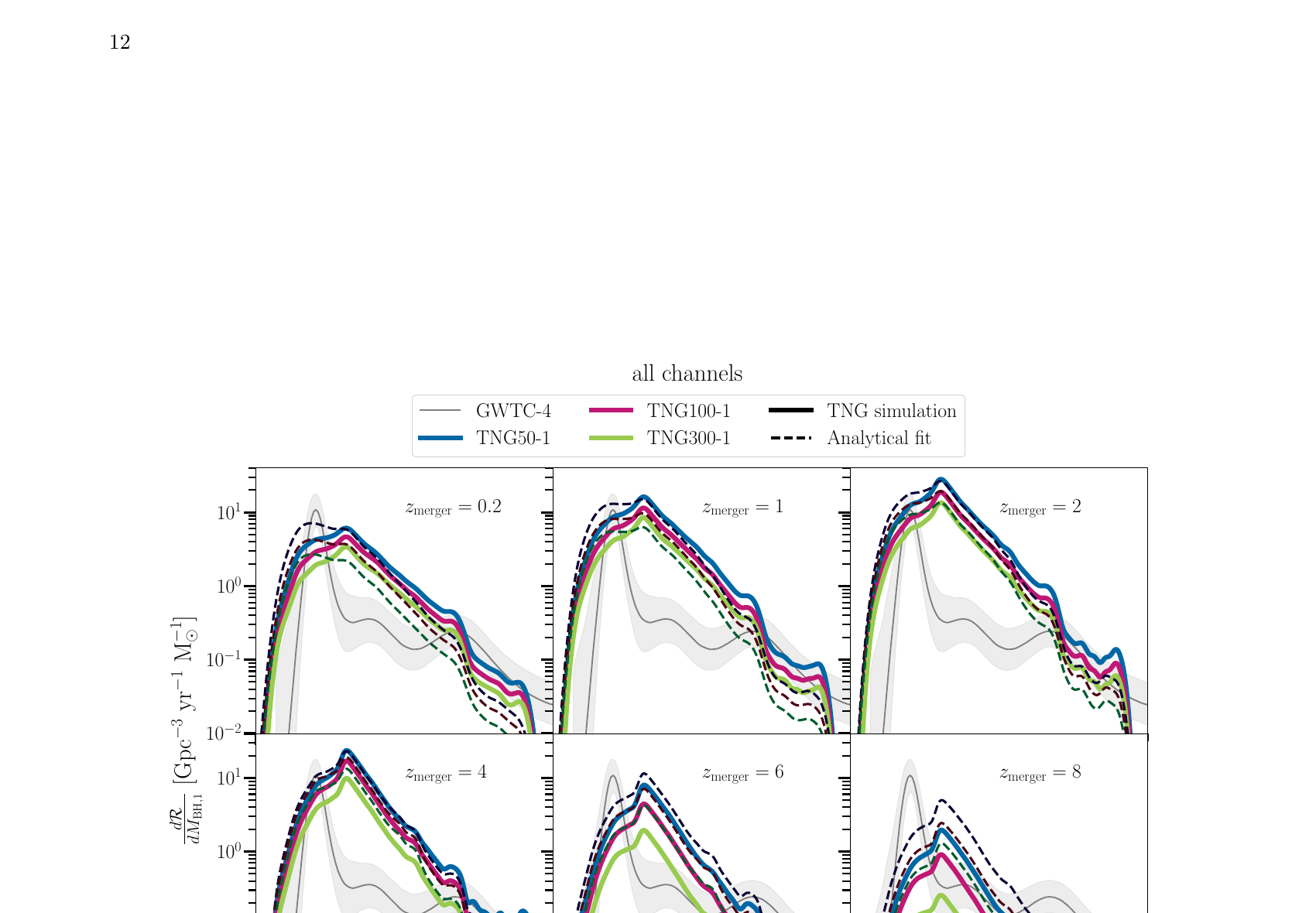
Levina et al. 2026 — From cosmological simulations to binary black hole mergers: The impact of using analytical star formation history models on gravitational-wave source populations January 28, 2026
Sasha Levina, Floor Broekgaarden, Lieke van Son, Emanuele Berti, Amedeo Romagnolo, Ruediger Pakmor, Ana Lam
arXiv:2601.20202
To predict how many binary black hole mergers gravitational-wave detectors like LIGO and Virgo should see, theorists must combine a model of how stars form across cosmic time — the star formation history (SFH) — with a model of how binary stars evolve into merging black holes. In practice, most studies use simple analytical SFH models (e.g., power laws or fits to galaxy survey data), but these are approximations of a far more complex underlying reality. This paper asks: how much does the choice of analytical SFH model actually matter?
The team uses the IllustrisTNG cosmological simulation as a ground truth for the star formation history and metallicity evolution of the universe, and compares it against four widely-used analytical SFH prescriptions. By running binary population synthesis models with COMPAS on top of each SFH, they quantify how the choice of SFH propagates through to predictions for BBH merger rates and mass distributions detectable by current and future gravitational-wave observatories.
A key finding (Figure 4 below) is that the predicted merger rate can vary by up to a factor of ~2–3 depending on which analytical SFH model is used, with the differences being most pronounced at high redshifts. This has direct implications for next-generation detectors like the Einstein Telescope and Cosmic Explorer, which will be sensitive to mergers across cosmic history. The metallicity evolution built into each SFH model is the primary driver of the spread: models that assign lower metallicities to star-forming gas at high redshift predict more BBH mergers because low-metallicity stars retain more mass and more readily form heavy black holes.
Figure 6 shows how the mass distributions of detectable BBH mergers shift depending on the SFH choice, with the IllustrisTNG-based prediction bracketed by the analytical models. The results underscore that SFH uncertainty is a non-negligible systematic in population-level gravitational-wave analyses — and that using cosmological simulations as a calibration anchor can help identify and bound this uncertainty.