
GWTC-5: My Summary of the New Gravitational Wave Catalog
Posted May 29, 2026 — This is my astrophysics-focused summary of the new GWTC-5 gravitational-wave catalog papers released by the LIGO–Virgo–KAGRA (LVK) collaboration. It is a biased summary: I come at this from the angle of trying to use gravitational-wave data to understand the lives of massive stars, and the results I find most exciting reflect that. I gave a talk on this for the group this week; some of the thoughts below are drawn from that discussion.
Part I: What is GWTC-5?
GWTC-5 was released earlier this week — a suite of at least eight papers plus a new catalog. In a sentence: LVK has announced their gravitational-wave detections from the second half of their fourth observing run (O4b), analyzed the full combined dataset, and released a range of scientific results built on those detections.
Three things happened simultaneously:
- LVK published the new individual compact-binary merger detections from O4b, including estimated source properties (masses, spins, distances).
- These are added to previous detections from O1, O2, O3, and O4a, forming GWTC-5 — the fifth gravitational-wave transient catalog, with over 390 candidates in total.
- Using this expanded dataset, LVK analyzed population properties, cosmological constraints, tests of general relativity, and lensing signatures — each as a separate companion paper.
One thing I love about this release is the video below, originally shared by Gabriele Vajente. It shows the growth of the "stellar graveyard" — a visualization of the masses of all compact objects detected with gravitational waves, accumulating over time from O1 through O4b. It really drives home how rapidly this field is growing.
Below is the official timeline of observing runs from the Intro paper. Between runs, LVK improves their detectors — sometimes substantially — so each new run typically covers a larger sensitive volume. The increase in detection rate is not just a matter of running longer; it reflects real engineering improvements including quantum squeezing, upgraded laser power, and better noise characterization.
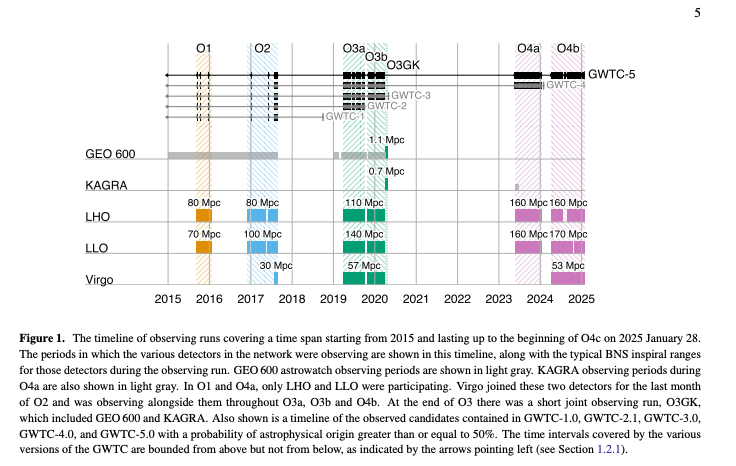
The GWOSC catalog website is a fantastic resource — for anyone wanting to explore the data yourself, you can download a simple CSV of all events (with masses, spins, distances, SNRs) and play with it in a spreadsheet or Python notebook:
→ GWOSC catalog: gwosc.org/eventapi/html/GWTC/
The catalog now contains 391 events. When I started working in gravitational waves around 2016, we knew all the event names by heart. Those days are gone.
Part II: The Companion Papers (Brief Overview)
Here are the eight papers in the release (2 are still to come out):
- Intro: arXiv:2605.27223 — overview of the observing runs, detector network, and catalog conventions
- Methods: arXiv:2605.27224 — how raw data become a catalog of events with inferred source properties
- Open Data: arXiv:2605.27090 — what data are publicly available and how to access them
- GWTC-5 Catalog: arXiv:2605.27225 — the new detections from O4b ⭐
- GW Populations: arXiv:2605.27226 — population properties of compact binaries ⭐
- GWTC-5.0: Constraints on the Cosmic Expansion Rate and Modified Gravitational-wave Propagation: arXiv:2605.27227 — constraints on cosmic expansion and modified GW propagation
- GWTC-5.0: Tests of General Relativity (to be published soon)
- GWTC-5.0: Searches for Gravitational Wave Lensing Signatures (to be published)
I'm most interested in papers 4 and 5, which are what I'll focus on below. But a quick note on a few of the others:
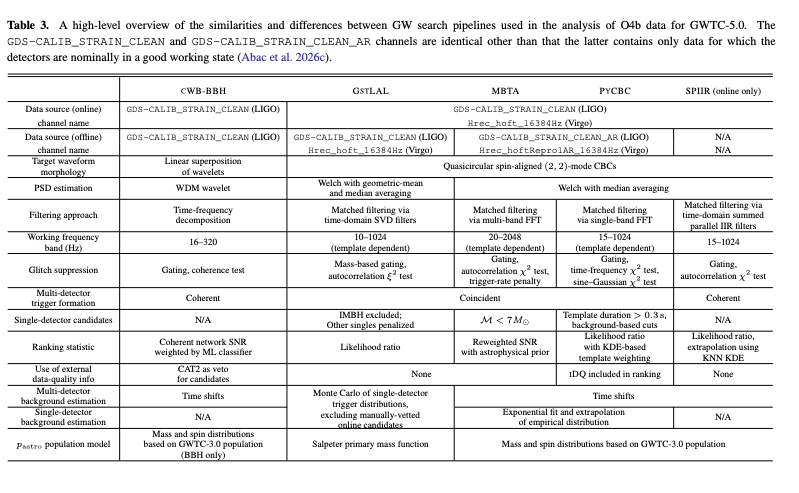
The Methods paper describes the full pipeline from raw detector data to a catalog entry: how signals are found, how fake events ("glitches") are vetoed, how false-alarm rates are estimated, and how source properties like masses and spins are inferred via Bayesian parameter estimation. A key thing to appreciate is how many different independent search pipelines are involved. The table below shows some of them. Each pipeline has its own strengths and weaknesses, and having multiple is important — some events are only found by one pipeline.
The Open Data paper is a user guide to everything LVK has made publicly available — raw strain data, posterior samples for each event, and reproducible figure notebooks. I want to highlight this because I think it genuinely sets a high standard for open science. The community has put enormous effort into making the data immediately usable by anyone, including independent parameter-estimation pipelines from groups outside LVK. Every figure in the papers can be reproduced from downloadable data files. That is not trivial, and it is something our community should be proud of and replicate.
Part III: The Catalog Paper — New Detections from O4b
The Numbers
- 161 compact binary coalescence candidates with pastro > 0.5 (the astrophysical origin probability)
- 104 events with FAR < 1 yr−1 — a false-alarm rate of less than once per year — for which LVK performed detailed parameter estimation; these form the high-confidence catalog (~88% purity)
- All consistent with binary black holes (BBH) based on inferred masses — no binary neutron stars (BNS), no neutron star–black hole (NSBH) systems
- 5 BBH signals with network SNR > 30, with the highest ever recorded SNR of 76.9 for GW250114_082203
- Combined with previous catalogs: 390 total candidates with pastro ≥ 0.5
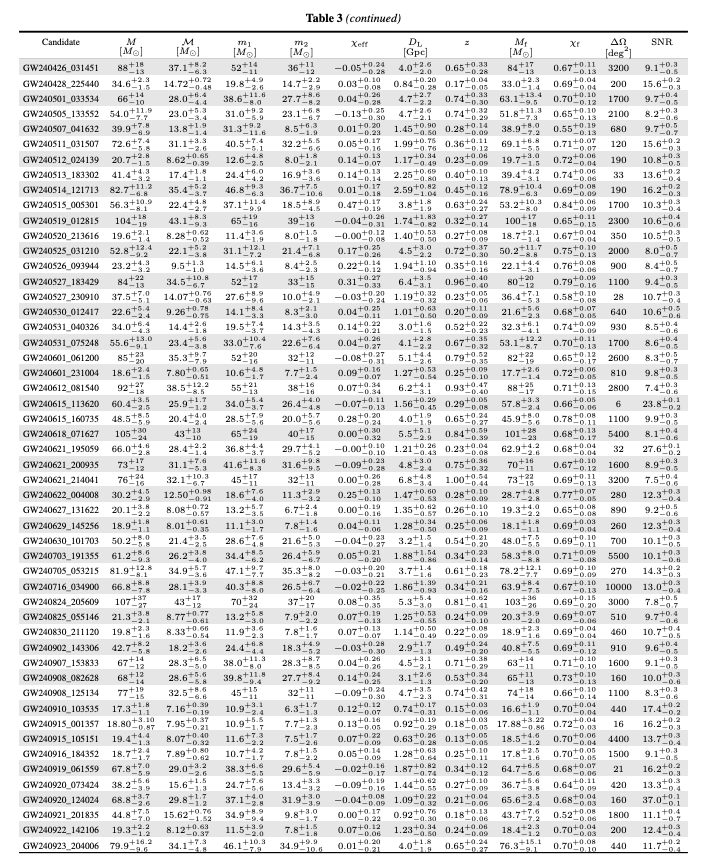
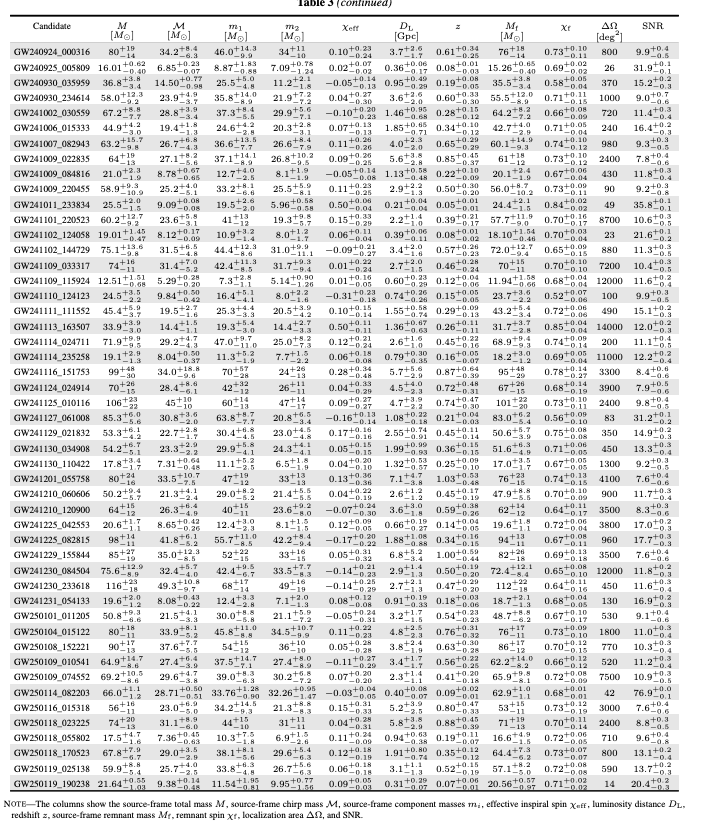
The full catalog table is large, but here is part of it — all the O4b events, listed by date with their total mass, component masses, effective spin χeff, luminosity distance, sky area, and SNR:
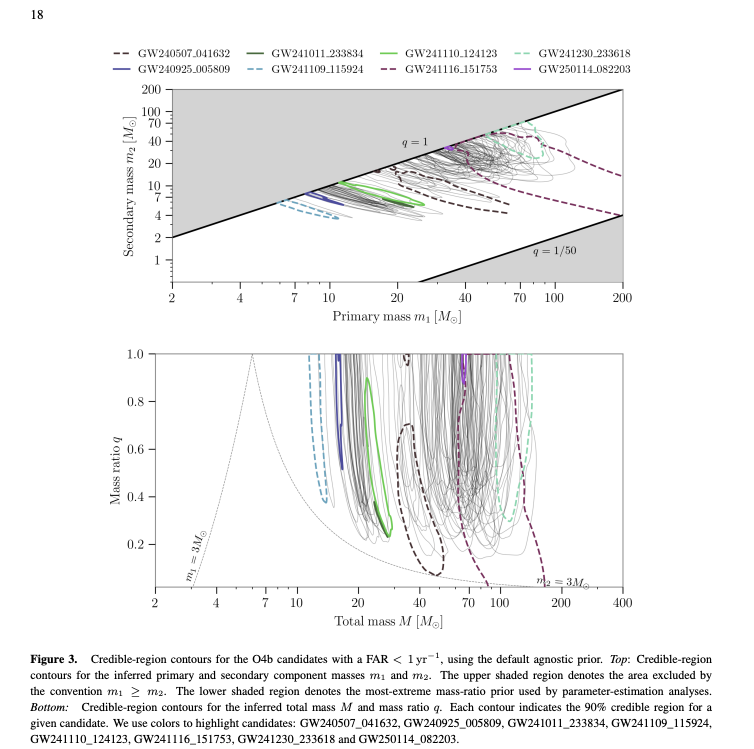
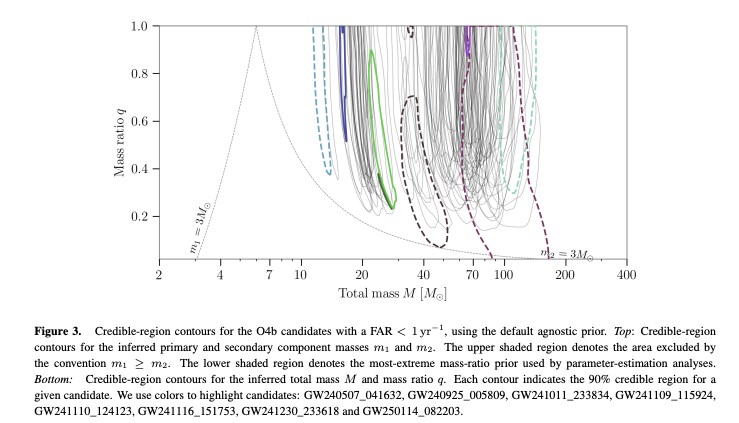
The figure below shows the 90% credible-region contours for all O4b events in the m1–m2 mass plane (top) and the total mass–mass-ratio plane (bottom), with highlighted events in color:
Highlighted Events
Network SNR of 31.9. This is a high-quality event used to inform detector calibration studies.
Total mass ~25 M☉, with a primary of ~20 M☉ and a secondary of ~6 M☉ — a mass ratio of roughly 1:3. The primary has a well-measured spin that is misaligned with the orbit, with a positive effective inspiral spin χeff ≈ +0.5. The misaligned spin and mass ratio suggest a possible hierarchical merger origin — the idea that the primary black hole is itself the product of a previous black hole merger — pointing to formation in a dense stellar environment (e.g., a globular cluster or nuclear star cluster). With a luminosity distance of just ~0.21 Gpc, this is likely the closest of the new O4b candidates.
A caveat: hierarchical merger models might typically produce more massive black holes at this stage (think 25+20 rather than 20+6), with perhaps only the 1G (first-generation) black holes producing the really lower-mass end — see e.g. arXiv:2208.01081 (Figure 1). That said, arXiv:2507.07183 do find low-mass (<15 M☉) black holes from cluster formation, though it remains unclear whether those models would produce systems matching all of the observed properties of GW241011_233834 simultaneously — the unequal mass ratio, the spin, and the individual masses. So the picture is intriguing but not clean, and this is one where I would love to see detailed model comparisons.
Another unequal-mass system, with a spinning primary roughly twice as massive as the secondary — also a possible hierarchical merger candidate. The mass ratio is less well-constrained here.
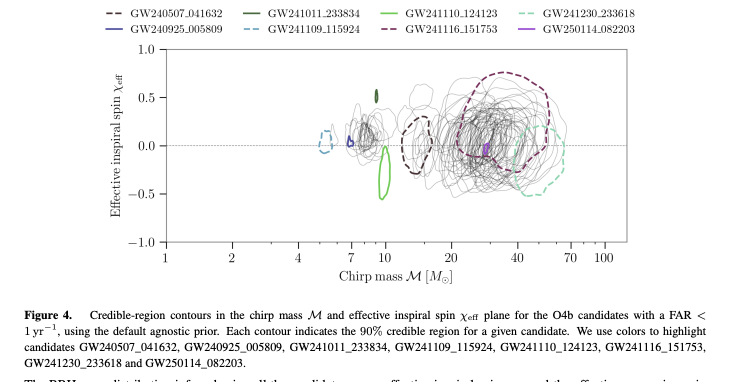
This event is especially interesting because it may be the first gravitational-wave event to require a negative effective inspiral spin (χeff < 0), with a median of −0.31+0.23−0.18 (90% credible interval). I'll return to this below — it is one of the most puzzling aspects of the entire GWTC-5 release.
The most precisely localized gravitational-wave source to date, with a 90% credible sky area of just 6 deg2. For context, typical GW events are localized to hundreds or even thousands of square degrees. This is an extraordinary improvement that enables much more targeted electromagnetic follow-up.
A BBH with the highest network SNR ever recorded: 76.9. For reference, GW150914 — the first detection — had an SNR of about 24. This unprecedented signal quality allows for very precise measurements of source properties and stringent tests of general relativity. This is the kind of event that the whole community gets excited about.
The Spin Puzzle (Preview)
One of the most intriguing aspects to note at the catalog level is the overall picture of effective inspiral spins. Out of ~300 gravitational-wave detections to date:
- Roughly 4–10 events clearly require a positive χeff (spin aligned with the orbit)
- Essentially no event clearly requires a negative χeff — until possibly GW241110, which still has large uncertainties
- The vast majority of events are consistent with χeff ≈ 0 (small or zero spins)
This is already puzzling from a formation standpoint: if binary black holes formed purely through dynamical processes (e.g., in globular clusters), you'd expect spin orientations to be random — equally likely to be aligned or anti-aligned with the orbit, giving a symmetric χeff distribution around zero. The fact that we see more events with positive χeff already suggests some contribution from isolated binary evolution, where tidal interactions tend to align spins. But the full picture from the Populations paper (below) makes this even more puzzling.
Part IV: The Populations Paper — What the Catalog Tells Us Collectively
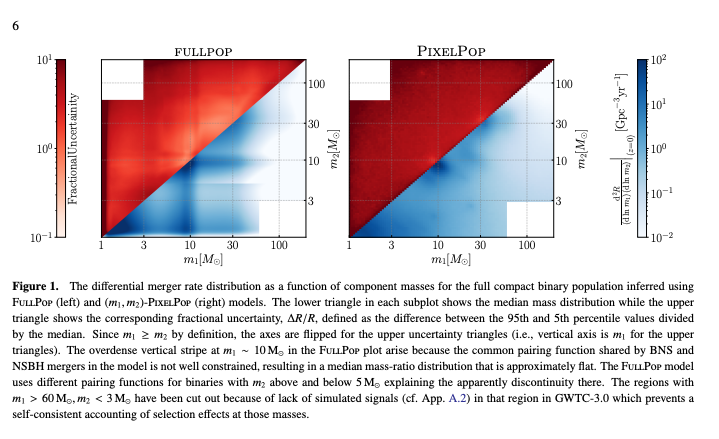
The Populations paper (arXiv:2605.27226) takes all the gravitational-wave events — not just the new O4b ones — and infers what the underlying population of binary black holes and neutron stars looks like. Rather than characterizing individual events, it asks: what is the distribution of masses, spins, and merger rates across the population?
Two complementary modeling approaches are used throughout, this is how I think about it intuitively:
| Parametric model (FullPop) | Non-parametric model (PixelPop) |
|---|---|
| Assumes a specific functional form (e.g., broken power law + Gaussian peaks); infers a small set of parameters | Divides parameter space into bins; infers the rate in each bin directly, assuming only smoothness between adjacent bins |
| Strong assumptions, low statistical uncertainty | Fewer model assumptions, but more uncertainty; can miss sharp features due to smoothing |
Merger Rates
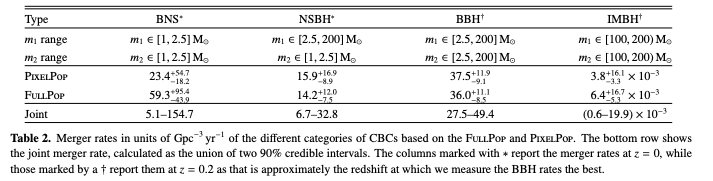
A few things to note from the rates:
- The BNS rate has decreased somewhat compared to earlier estimates. I'm actually not worried about this — the earlier high estimates were heavily influenced by GW170817, a very nearby and loud event. When you observe one event that close, you extrapolate to many more at larger distances, inflating your rate estimate. As the sample grows and becomes more representative, the rate naturally converges to something more reliable.
- The BBH rate remains broadly consistent with previous estimates, with slightly smaller uncertainties.
- There is a non-zero IMBH rate — tantalizing, but very uncertain.
Mass Distribution
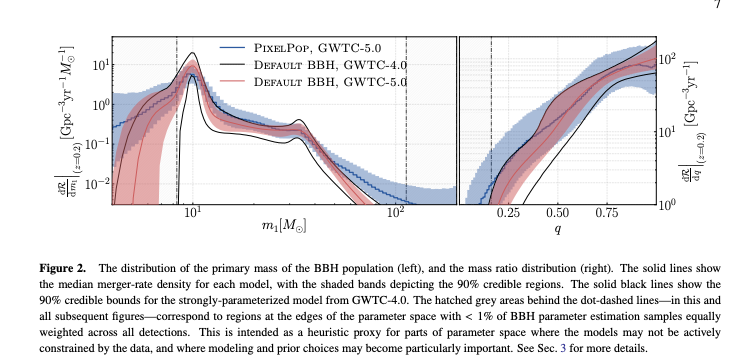
Key results from the mass distribution:
- No empty gap between 3–5 M☉. With GWTC-5, the models rule out a completely empty "lower mass gap." This is now very solidly established: binary black holes do form black holes in what was historically thought to be a forbidden mass range between 3 and 5 solar masses. This was initially thought to be empty based on (few) X-ray observations that showed no Black holes in this mass range. With the increase of black hole masses from gravitational waves (but also through GAIA and spectroscopic discoveries of black holes, we now have a growing and confident population of black holes with masses in the range 3-5 solar masses
- Features at ~10 M☉ and ~35 M☉ in the primary mass distribution continue to appear across models. Their origin is debated — they may reflect features in the stellar initial mass function, the pair-instability supernova mass spectrum, or something else entirely.
- The distribution extends to high masses without going to zero, confirming that BBH systems with m1 ~ 70–100 M☉ do form and merge.
- No clear pair-instability supernova (PISN) gap. Although the primary-mass distribution steepens at high mass, it extends smoothly beyond 50 M☉ with no clean cutoff. Early on, many theoretical models predicted a PISN mass gap — a range of black hole masses that stellar evolution cannot produce directly, because very massive stars that would produce black holes in the range of 50-100 solar masses are disrupted completely by pair-instability supernovae before collapse. The data suggest that if such a gap exists, it is being filled — most likely by hierarchical mergers from dense stellar environments, which can build up black holes above the PISN threshold one merger at a time. This is a really important result: it's a reminder that the observed mass spectrum is probably a superposition of multiple formation channels, and clean theoretical features get mixed and washed out in the data.
- The mass ratio distribution peaks near q = 1 (equal mass), with evidence for a gradual decline toward more unequal mass ratios.
Spin Distribution
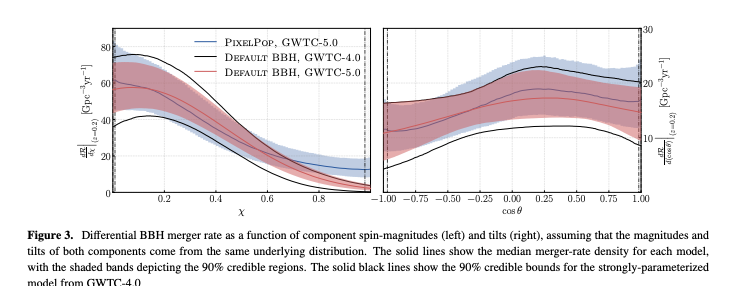
The spin results are fascinating and somewhat puzzling. Most BBH systems have small spin magnitudes — the population peaks near zero. But there is a subset with meaningfully large spins, and the tilt distribution shows some preference toward alignment.
The Chi_eff Puzzle
This is the result I find most striking — and most confusing — from this entire release. Here is Figure 4 from the Populations paper:
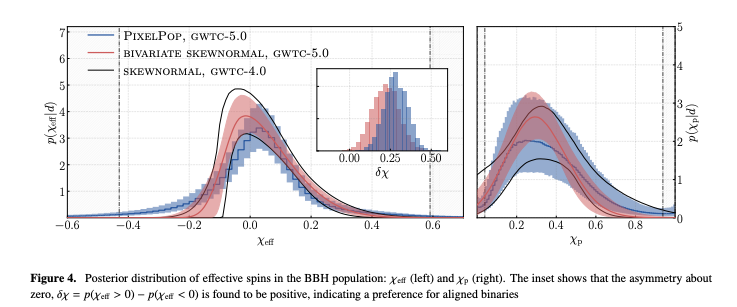
What the paper finds:
- The χeff distribution is asymmetric: more probability lies above zero than below, meaning more systems have spins preferentially aligned with the orbital angular momentum.
- By calculating the union of 90% credible intervals, they estimate that at least 9–40% of mergers must originate from preferentially aligned channels (e.g., isolated binary evolution) to explain the observed asymmetry.
- At the same time, they find that 39 ± 7% of binaries have negative χeff (according to the Bivariate Skewed model; 36 ± 6% from PixelPop), indicating systems with at least one black hole spin misaligned by more than 90° with respect to the orbit.
Here is where it gets confusing. If you take the 39% negative χeff value at face value, you would reason: for every misaligned (negative χeff) system, a purely dynamical channel should produce an equally likely aligned one. So if ~40% are negative, then ~40% should be positive from the same channel, meaning ~80% of all events come from dynamically formed systems. That is a very strong claim — and it seems to be in tension with what you see from individual events, where already a handful clearly require positive χeff and almost none clearly require negative χeff.
My honest take: I am not convinced. The χeff measurement is notoriously difficult — it is strongly correlated with the mass ratio and other parameters, and spin inference from current detectors is genuinely hard. Furthermore, the PixelPop approach has a known limitation: even if the true χeff distribution were a delta function at zero, the smoothness prior would spread it into both positive and negative territory. So a distribution that peaks near zero will always "leak" into the negative. I think the evidence for a significant negative-χeff population is intriguing but not yet compelling. I want to see a few more events like GW241110 — ones that individually require negative χeff — before drawing strong conclusions.
That said, the asymmetry toward positive χeff is real and persistent across catalogs. At least some fraction of binary black holes does form through a channel that aligns spins — almost certainly including some contribution from isolated binary evolution. The question of how much remains very much open.
The χeff–q Correlation: an Earlier Puzzle That Is Fading
One result I find especially interesting — and somewhat reassuring — concerns the reported correlation between χeff and mass ratio q. Since GWTC-2.0, several analyses had reported a trend where more unequal-mass systems (lower q) tend to have higher effective spins. GWTC-5.0 revisits this and finds decreased evidence that the mean of χeff evolves with q, but increased evidence that its width does — compared to GWTC-4.0.
Why does this matter? The earlier reported mean-shift correlation puzzled the stellar evolution community, because it is genuinely difficult to explain with standard formation physics. In most isolated binary evolution models, χeff is set by processes like angular-momentum transport, tidal synchronization, and stellar winds — while the mass ratio is determined earlier, by mass transfer and stellar evolution. These are largely independent channels, so a strong coupling between them is not naturally expected. Dynamical formation in dense clusters likewise tends to produce nearly isotropic spin distributions with no intrinsic link to mass ratio. Explaining the trend required either fine-tuned evolutionary pathways, selection effects, or multi-channel complexity (hierarchical mergers, metallicity-driven correlations, etc.).
The GWTC-5.0 finding that the mean correlation is weakening — while the width of χeff may vary with q — is both a relief and a new puzzle. It suggests the earlier signal may have been partly a statistical fluctuation or a prior artifact, which would simplify the formation interpretation considerably. But a broadening of the χeff distribution at certain mass ratios is itself interesting and warrants follow-up. As always: more data, more complexity.
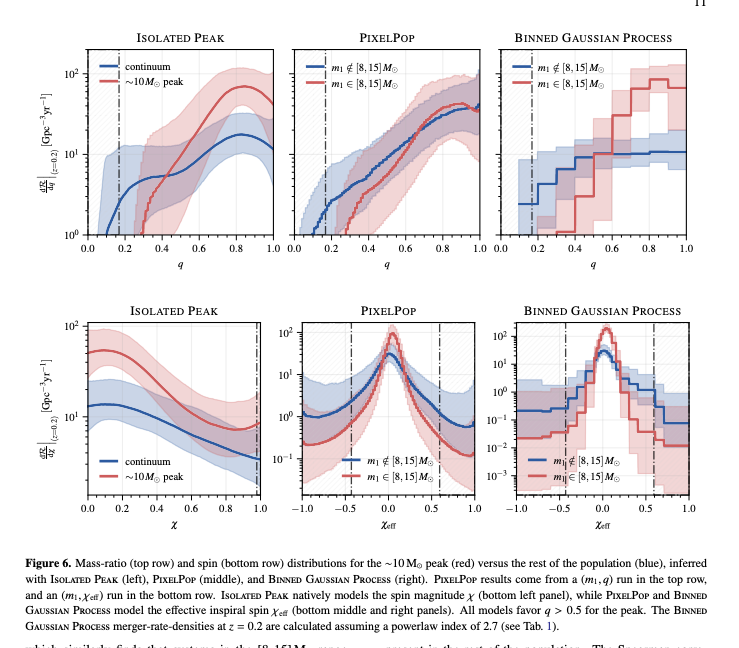
Isolating the 10 M☉ Feature
One of the neatest analyses in the Populations paper is an attempt to characterize the ~10 M☉ feature in isolation. By comparing the mass ratio and spin distributions of BBH systems near the 10 M☉ peak to the rest of the population, the paper finds that these systems tend to be more symmetric in mass ratio (q closer to 1) and show a different spin distribution. This is suggestive of a distinct formation pathway — possibly isolated binary evolution, where mass transfer naturally tends to produce near-equal-mass remnants. Testing this more rigorously with large grids of theoretical models is something I think is genuinely valuable, and not yet done systematically in the literature.
Redshift Evolution
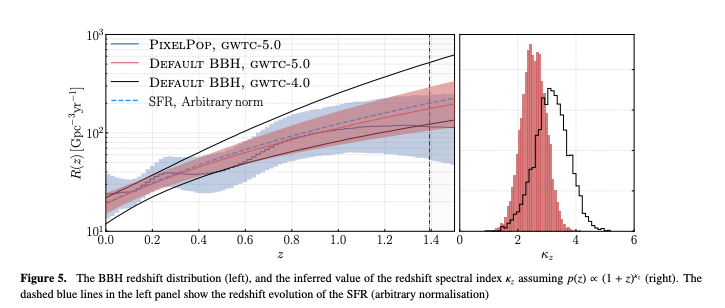
The BBH merger rate rises with redshift, broadly following the star-formation rate — as expected, since most black holes ultimately come from massive stars that formed earlier in cosmic history. But the new inferred slope is slightly shallower than in previous catalogs. This is interesting for the modeling community: a gentler redshift evolution may favor longer delay times between star formation and merger, or a steeper metallicity dependence in the mass spectrum.
Final Thoughts
GWTC-5 is an extraordinary release. The sheer number of detections (390+ total) and the quality of the loudest events (SNR up to 76.9) represent a new era for gravitational-wave astronomy. A few things I personally find most exciting or most puzzling:
- No neutron star detections in O4b. This is not entirely surprising given the volume, but it is a reminder that binary neutron stars are rare — or at least their merger rate has decreased from early estimates. For those of us trying to understand r-process enrichment and the origin of heavy elements, this matters.
- The ~10 M☉ and ~35 M☉ features in the mass spectrum are real and persistent. These are crying out for a systematic comparison to theoretical models across a large range of assumptions about stellar physics and binary evolution.
- No PISN gap. The primary-mass distribution extends smoothly past 100 M☉ with no clean cutoff. This is a strong hint that multiple formation channels are overlapping in the observed spectrum, with hierarchical mergers filling in any intrinsic pair-instability gap.
- The χeff–q mean correlation is weakening. The earlier reported trend (more unequal-mass systems tend to have higher χeff) was hard to explain with standard formation models and may have been partly a statistical fluctuation. GWTC-5.0 finds the evidence for a mean shift is decreasing, which simplifies the picture — though the width of the χeff distribution may still evolve with q.
- The spin story is genuinely confusing. The population-level analysis says ~40% of systems might have negative χeff, yet individually we can barely find one. Something about how we infer the population from noisy individual measurements is making this hard to interpret. I'd rather wait for more high-SNR events with clear individual spin measurements before drawing firm formation-channel conclusions.
- GW250114 with SNR = 76.9 is a gift. High-SNR events do more for science per event than many low-SNR detections combined. Improving detector sensitivity is genuinely the best way to advance the field, not just accumulating more marginal candidates.
The next step is O4c, whose public alerts are already visible online. Word on the street (and a quick look at the latest alerts) suggests no binary neutron star events there either — though the story can always change once the full catalog analysis is done. And then O5 looms on the horizon, promising another major leap in sensitivity.
It's a great time to be in this field.
Note: This is a personal summary written from an astrophysics/formation-theory perspective. I have not read all the papers in full detail and some statements here may be imprecise. For the authoritative results, please refer directly to the LVK papers linked above. All figures are from the LVK GWTC-5 papers and are reproduced here for educational commentary.